


The bonus that took eleven weeks to clear
A few years back I took a £50 reload bonus at a UK operator that came with 8x wagering at minimum odds of evens. Eleven weeks of disciplined football betting later, I cleared the wagering and withdrew about £38 in net cash. The bonus had nominally been worth £50. The actual realised value was £38, after eleven weeks of effort and the opportunity cost of having my bankroll committed to wagering-friendly bets I wouldn’t otherwise have made.
That experience taught me what every UK punter chasing reload bonuses eventually learns: wagering requirements are the operator’s protection against bonus abuse, and they’re calibrated precisely so that the average punter clearing the bonus has it returned to the operator as margin during the wagering process. The bonus is real money, but extracting it requires discipline that most retail punters don’t have.
How wagering requirements actually work
A wagering requirement — sometimes called “turnover”, “rollover”, or “playthrough” — specifies how much you have to bet before bonus funds become withdrawable cash. An “8x wagering on bonus only” requirement on a £50 bonus means £400 in total bets at qualifying odds before the bonus converts.

Different operators structure wagering differently. Some apply it to “bonus only” — only the bonus credit counts towards the requirement. Others apply it to “deposit plus bonus” — both your deposit and the bonus need to be wagered. A “10x deposit plus bonus” requirement on a £50 deposit and £50 bonus is £1,000 in wagering, far more than the headline “10x” number suggests.
Reading which structure applies is the first step in evaluating any UK football bonus. The operator’s terms specify it clearly, usually buried in a sub-clause halfway down the promotional T&Cs page. Punters who skip this step end up wagering far more than they realised and find themselves clearing what feels like a generous bonus on what’s actually a heavy turnover commitment.
Minimum odds restrictions and what they cost you
Most UK football bonuses come with minimum odds restrictions on qualifying bets. Common thresholds: 1/2 (1.50), 4/5 (1.80), evens (2.00), or 6/5 (2.20). Bets at odds below the threshold either don’t count towards wagering at all or count at a reduced rate.
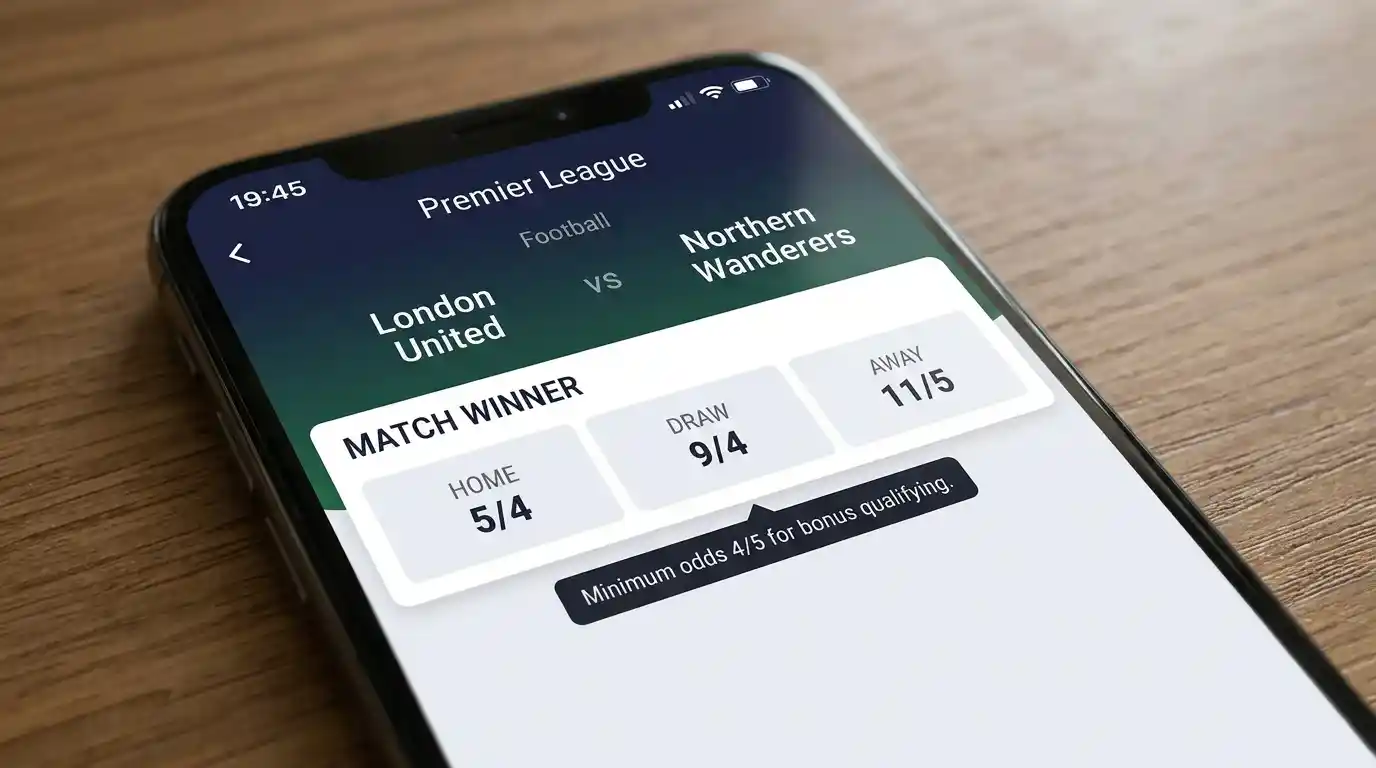
The minimum odds restriction shapes which markets you can use to clear the bonus. A 4/5 minimum essentially rules out backing heavy favourites in handicap markets, short-priced match outcomes, and most “under” goal lines. It pushes punters towards the BTTS market, mid-priced match outcomes, and double chance bets — all of which carry overrounds in the 106-110% range.
Mathematically, every £1 wagered at a 7% overround costs about £0.07 in expected value. Clearing £400 in wagering through markets averaging 7% overround costs around £28 in expected loss. On a £50 bonus, that leaves £22 expected net realisation. That’s typical UK reload bonus economics — the headline number is roughly halved by the wagering cost.
The contribution rate trap
Some UK operators apply different “contribution rates” to different markets when calculating wagering. A bet at evens on a Premier League 1X2 might contribute 100% of stake towards wagering. A bet on Asian handicap might contribute 50%. A bet on goalscorer markets might contribute 25%.
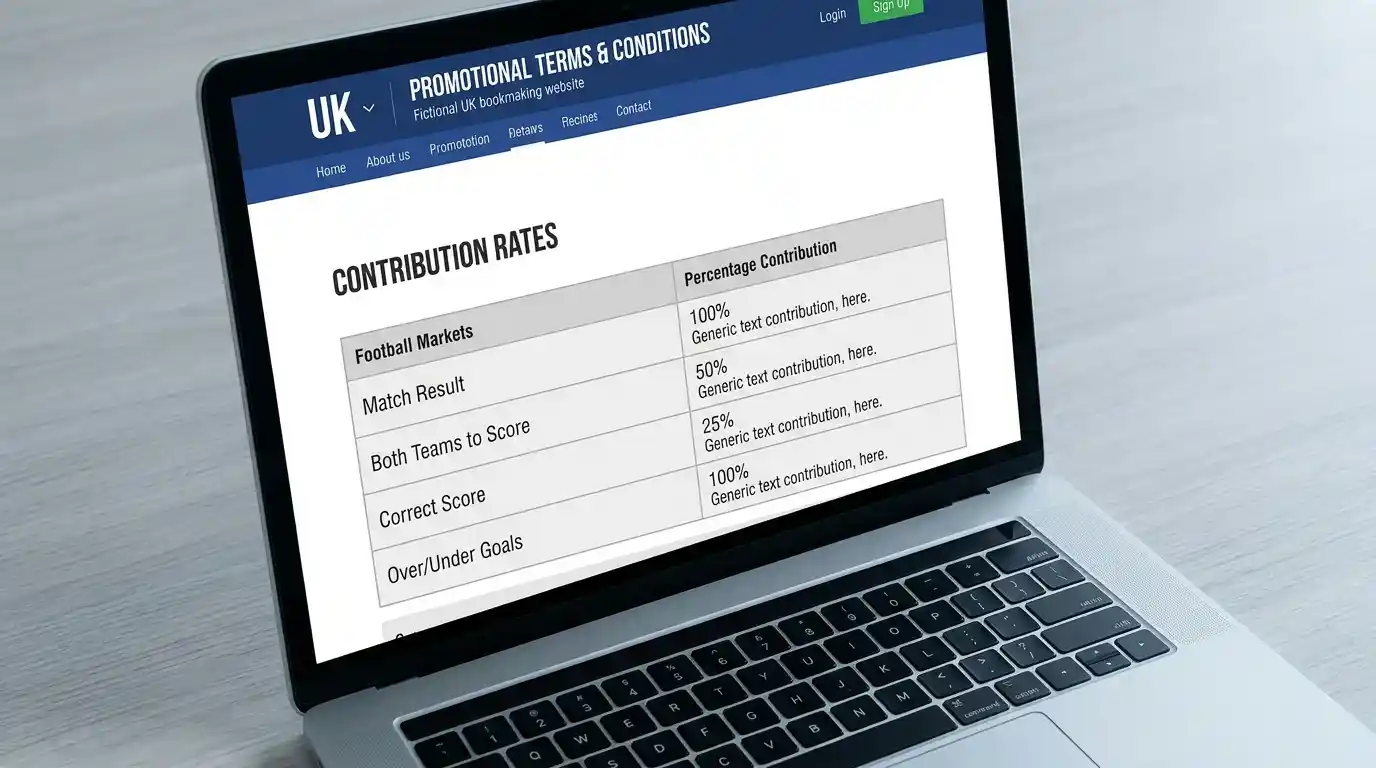
The contribution rate effectively multiplies the required turnover for non-100% markets. An 8x wagering bonus at 25% contribution on goalscorer bets becomes effectively 32x — £1,600 in goalscorer wagering for a £50 bonus. The maths is brutal and most punters miss it entirely.
The contribution rate structure is also why operators load up the qualifying markets list. To illustrate the range — using hypothetical operators for comparison only — Operator A might exclude exchange-style markets entirely from wagering. Operator B might include them at full rate. Operator C might include them at 10%. The variation makes it impossible to compare bonus value across operators without reading each set of terms in detail. UK gambling reported 34M new registrations across the licensed market last year — and a meaningful share of those registrations occurred specifically to claim bonuses that the registering punter never managed to clear.
Maximum bet limits during wagering
The other structural protection operators build into bonuses is a maximum bet limit during the wagering period. Typical limits sit at £5 or £10 per bet while bonus funds are active in your account. Breach the limit and the bonus voids — you lose any associated winnings and the original bonus credit.

The £5 max bet on a £400 wagering requirement means a minimum of 80 separate bets to clear. That’s roughly one full Premier League season of weekly betting if you stick to single match outcomes. The operator’s structural intent is clear — they want the wagering process to take long enough that the punter loses interest, makes a mistake, or simply forgets to follow through.
The maximum bet limit also rules out using bonus credit on a single big-stake value play. If you spot a genuinely mispriced market at 3/1 and want to back it £50, you can’t — your bet would exceed the max bet limit and void the bonus. The bonus structure forces small, distributed stakes regardless of the punter’s read on the market.
Wagering-friendly bet structures that actually work
The football bets that clear wagering most efficiently — at lowest expected cost — are bets at the minimum qualifying odds in markets with tight overrounds. The market that’s almost always tight enough to use efficiently is the Asian handicap market, where overrounds run 102-103%.

A series of even-money Asian handicap bets at 102.5% overround costs roughly £2.50 per £100 wagered. Clearing £400 in wagering costs about £10 in expected loss — much better than the £28 typical retail wagering would cost. That’s the difference between a £40 net realised bonus and a £22 net realised bonus on the same headline £50 credit.
The catch is that not all operators include Asian handicap markets in their bonus contribution structure. Where they do, the bonus is meaningfully more valuable. Where they exclude it, the punter is forced into higher-overround markets and the realised value falls. Always check the qualifying markets list before deciding whether a bonus is worth claiming.
Time limits and the forced-pace pressure
UK football bonuses typically come with expiry dates — anywhere from 7 days to 90 days to complete the wagering requirement. The time limit matters because it forces a betting pace that might not align with your normal football betting volume.

A 7-day expiry on a £400 wagering requirement means averaging £57 per day in qualifying bets. That’s high frequency for most retail punters and pushes them into impulse bets, in-play wagering, and markets they wouldn’t normally touch. The time pressure systematically degrades selection quality, which is exactly what operators want.
The 30-day and 90-day windows are more manageable. They let the punter stick to their normal weekend football routine and naturally accumulate wagering through bets they’d make anyway. The longer the window, the more valuable the bonus in practice — the punter isn’t forced off their normal selection discipline.
The regulatory backdrop and where bonus terms are heading
UK promotional structures have tightened under regulatory pressure over the last five years. The 2026/27 Premier League season brings front-of-shirt sponsorship restrictions, and the same regulatory direction has reshaped bonus terms more broadly. The Gambling Commission and the Advertising Standards Authority have pushed operators towards clearer disclosure of wagering requirements, mandatory display of conversion rates, and restrictions on the kind of “100% match bonus up to £500” headline numbers that historically obscured the actual realised value.

The current generation of UK football bonuses is more honest than the bonuses of five years ago. Wagering multiples are typically lower (5x to 10x rather than 30x to 50x). Time limits are typically more generous. Contribution rates are typically disclosed clearly. The Betting and Gaming Council has emphasised across recent industry comment that responsible operators have to compete on transparency as well as on price — Grainne Hurst, who runs the council, has framed industry conduct standards repeatedly around the principle that licensed operators set themselves apart from the unregulated alternative by what they disclose to customers, not by what they promise in headlines.
That regulatory direction is broadly positive for the punter. The bonuses worth claiming are easier to identify because the terms are clearer. The bonuses that look generous but extract more value than they deliver are still out there, but they’re more obviously bad once you read the details. The 2026 promotional environment rewards punters who read terms carefully and punishes punters who chase headlines.
How to think about bonuses as a portfolio
The disciplined approach to UK football bonuses is to treat them as a small positive expected value stream that compounds over a season, not as a way to suddenly double your bankroll. A typical engaged UK punter might extract £150-300 per year in net realised bonus value across reload offers, free bet credits, price boosts, and acca insurance.
That’s meaningful but not transformational. The punter who builds bonus extraction into their normal betting routine — claiming reloads when terms are favourable, taking small-stake price boosts when value appears, building accas during acca-insurance promotional periods — produces a steady drip of positive expected value. The punter who chases bonuses as primary income produces concentrated losses, because the wagering requirements were designed precisely to catch that behaviour.
UK gambling reported £1.3bn in football GGY last year. A meaningful portion of that came from bonus-related wagering that customers thought was “free money” but was actually carefully structured operator margin extraction. Understanding which side of that structure you’re on is the difference between bonuses being a small positive contribution to your annual football betting and bonuses being a substantial negative contribution.
Asian handicap markets at minimum qualifying odds, where overrounds run 102-103% against 106-110% on most other football markets. Across a £400 wagering requirement, the difference is around £18 in expected loss — roughly a third of a typical reload bonus. Always check whether Asian handicaps are included in the bonus contribution structure before committing. Usually not in the same way as deposit bonuses. Most UK free bet credits are "stake not returned" — the winnings withdraw immediately but the stake doesn"t. That removes the explicit wagering requirement but reduces the cash equivalent value of the credit to 50-67% of face value at typical football betting odds. To prevent risk-free clearing of the wagering requirement. Without the minimum odds restriction, punters could clear an 8x wagering bonus by betting both sides of a 1/9 favourite — losing minimal expected value while satisfying the turnover. The minimum odds threshold forces meaningful market exposure during wagering, which protects operator margin.What"s the lowest-cost way to clear a UK football wagering requirement?
Do free bet credits have wagering requirements?
Why do operators set such specific minimum odds on qualifying bets?
This material was created by the Pitchledger team.
