


Why a “£30 free bet” is rarely worth £30
The first welcome offer I ever cashed out paid me back roughly nineteen pounds on a thirty-pound promise. That was 2014, my second year on a London trading desk, and I felt clever about it for about a week — until I started pricing the same offers from the operator side and saw what the maths actually looked like. The headline number is the part that sells. The mechanics underneath are where the operator earns it back, comfortably, on the median punter.
I have spent twelve years modelling Premier League odds, analysing bookmaker margins and tracking UK gambling regulation, and I can tell you that the gap between what a welcome offer says and what it pays is the single most underestimated number in the British football betting market. Operators are not handing out free money. They are paying a known acquisition cost in exchange for a customer they expect to keep, and the design of the offer is the lever that makes the maths land in their favour.
The Gambling Commission’s own work tells you why this matters. Thirty-four percent of British players say bookmaker advertising has influenced their behaviour, and sixteen percent say it has directly increased how often they bet. Welcome offers sit at the sharp end of that influence. They are the first promotional message most punters ever see from a UK football operator, and they shape the way the customer reads every promotion that follows.
This article does not list offers. It explains how the headline becomes the payout, why most “free bets” return less than face value, and what changed in January 2025 when the rules on promotional emails were rewritten. By the time you finish, you should be able to read any UK football welcome offer and tell yourself, within thirty seconds, what you are actually being handed.
The anatomy of a UK football welcome offer
Pull apart any UK football welcome offer and you will find the same four bones holding it together — every time. Operators dress them differently, but the skeleton is identical. Once you can see it, you stop being surprised by the small print.
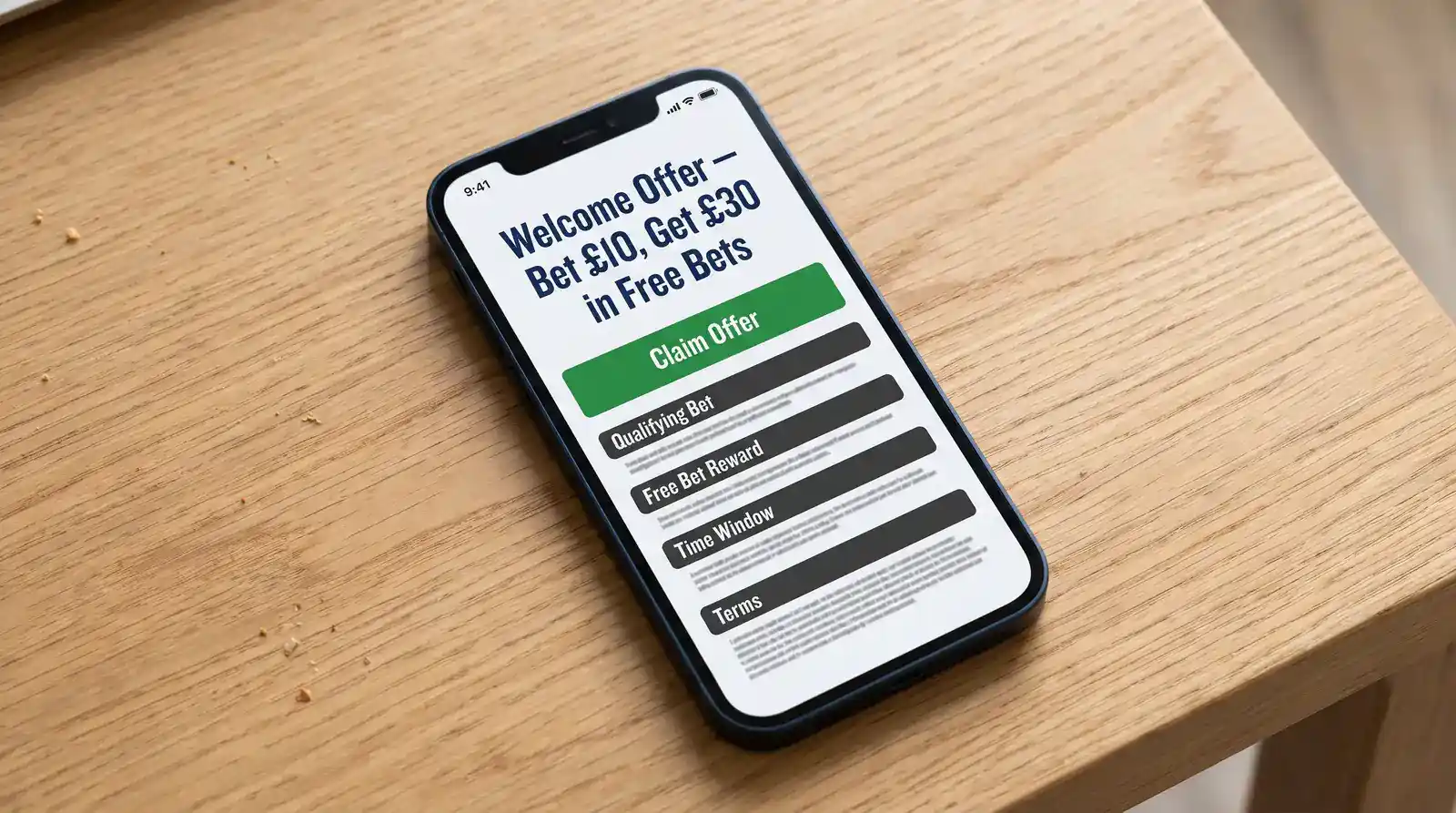
Bone one is the qualifying bet. You deposit, you stake real cash on a market that meets the operator’s conditions, and you wait for that bet to settle. The qualifying stake is almost always returned to your balance if the bet wins or loses — it is a real bet, not a token — but it must meet a minimum stake, a minimum odds requirement and a list of excluded markets. Bone two is the reward itself, almost always a free bet token or a set of tokens, not cash. Bone three is the wagering condition attached to whatever you win from the token. Bone four is the time window, after which the unused reward expires and the offer evaporates.
The structure means an operator can advertise a large number on the front of the offer while controlling what fraction of customers actually convert that number into withdrawn cash. The Adthena PPC data from early 2026 shows William Hill commanding 37.83 percent of click-through share on UK sports betting search ads, with bet365 at 16.2 percent — these are the two operators that have engineered welcome offers most carefully, and the click-through dominance reflects that engineering, not just brand recall.
Here is the simple test I use when a new offer lands in front of me. I ask three questions in order: what is the minimum odds floor, what is the conversion path from token to withdrawable balance, and what is the time window. If any of those three is hostile, the headline number is decoration. If all three are reasonable, the offer has at least a chance of being worth its face value to the median punter, not just to a value-betting specialist with a spreadsheet.
One last point on anatomy. The 2024–25 industry data from the Gambling Commission shows 24.4 million active accounts at remote casino, betting and bingo operators across Great Britain. Welcome offers are the funnel that fills that figure, and the cost of acquiring each of those accounts is built into the price you eventually get on a Premier League market. Nothing here is charity.
Qualifying bets, minimum odds and stake return
Most punters lose their first welcome offer at the qualifying-bet stage without even noticing. I have watched it happen on a trading floor more times than I can count: someone places the qualifying stake on a 1/2 favourite to “lock it in safely”, the bet settles, the token never arrives, and they are convinced the operator has stitched them up. The operator has not stitched them up. The customer skipped the minimum odds floor.
Almost every UK football welcome offer carries a minimum odds requirement on the qualifying bet, typically 1/1 (2.00 in decimal) but sometimes 1/2 (1.50) or 4/5 (1.80). The floor is there to stop a punter qualifying with near-certainties that would let them recycle the offer at minimal risk. From the operator’s perspective it is a margin control. From your perspective it is the first hidden filter.
The second filter is the list of excluded markets. Cashed-out bets almost never qualify. Bets settled as void do not qualify. Multiples where one leg has been part-settled at lower odds may not qualify even if the remaining legs sit above the floor. Some operators exclude entire bet types — request-a-bet markets, lottery-style scorecast pools, special promotions priced by human traders rather than the algorithmic engine. The exclusion list is sometimes longer than the offer description.
Stake return is the third filter and the one most people misread. The qualifying bet is a real bet, not a token. If it wins, you get your stake back plus winnings. If it loses, the stake is gone. The free bet token arrives regardless of whether the qualifying bet wins or loses — that is the universal pattern in the UK market — but the value of the token does not include your original stake. A “bet £10 get £30 in free bets” promotion means you risk £10 in cash, and you receive £30 of token value layered on top, but those tokens behave differently from cash in ways the next section covers.
The cleanest qualifying bet I tend to recommend on a Saturday football card is a single on a Premier League match-result market at fractional odds between 1/1 and 6/4. It sits above the minimum odds threshold at almost every UK operator, it avoids the void-related complications of correct-score or multi-leg markets, and it gets the offer cleanly into its second phase. Anything fancier on a qualifying bet is solving a problem that does not exist.

How free-bet stakes are returned — and when they are not
Here is the line that should be tattooed on every UK punter’s wrist: the stake on a free bet is not returned to you when the bet wins. That single rule is responsible for more disappointed welcome-offer screenshots than every other clause combined.
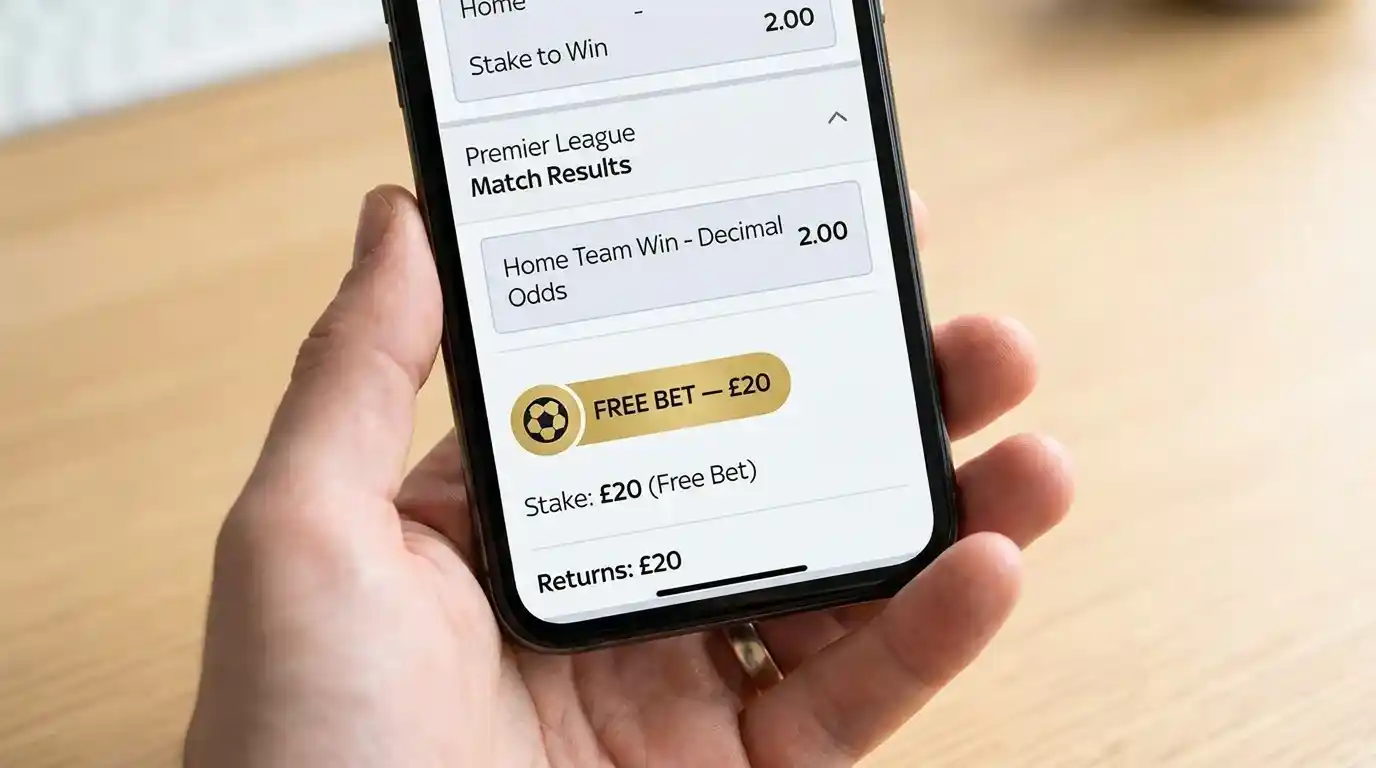
Suppose you receive a £20 free bet token, and you place it on a market priced at evens — 1/1, decimal 2.00. The bet wins. A cash bet at that price would return forty pounds: twenty pounds of returned stake plus twenty pounds of winnings. A free bet at that price returns twenty pounds of winnings only. The token has done its job and disappeared. You have not been short-changed by the operator — the terms always said this — but the effective value of the token has just halved compared to its face value, because the cash component is stripped from the return.
The implication for expected value is direct. A £30 free bet placed at evens generates £30 of winnings on a successful punt, and that £30 is the maximum value the token can deliver on that market. To match the face value of the offer in pure cash terms, you need the token to win — which means the implied probability of the chosen market puts a ceiling on the realistic value of the bonus before you even open the app. At even-money odds on a tight Premier League market, the implied probability of winning sits below fifty percent once overround is factored in, and the operator’s pricing already ensures that expected return on the token is well below its face value.
Some operators try to soften this with what they call “stake-returned free bets”, which behave exactly like cash. These are rare on welcome offers and far more common on ongoing promotions for established customers. If you see the phrase “stake returned” attached to a free bet, that token is materially more valuable than a standard free bet of the same face value. If you do not see that phrase, assume the stake is not returned.
One trick a lot of seasoned UK punters use is to push free bets onto markets with slightly higher prices than they would normally back. The maths is simple: because the stake does not return, you need the price to do more work to compensate. Backing a 5/2 outright with a free bet, where you would normally back evens with cash, shifts the expected payout in your favour. The trade-off is variance — you will see far more losing tokens — and any decision to push price has to be balanced against the wagering rules that come next.
Enhanced odds, price boosts and how operators recover the margin
Enhanced odds are the second-most-misunderstood promotion in the UK football market, and they account for a meaningful slice of the click-through volume that William Hill, bet365 and the rest of the leading operators command on search. A price boost looks like a gift. It is, in fact, an actuarial product.
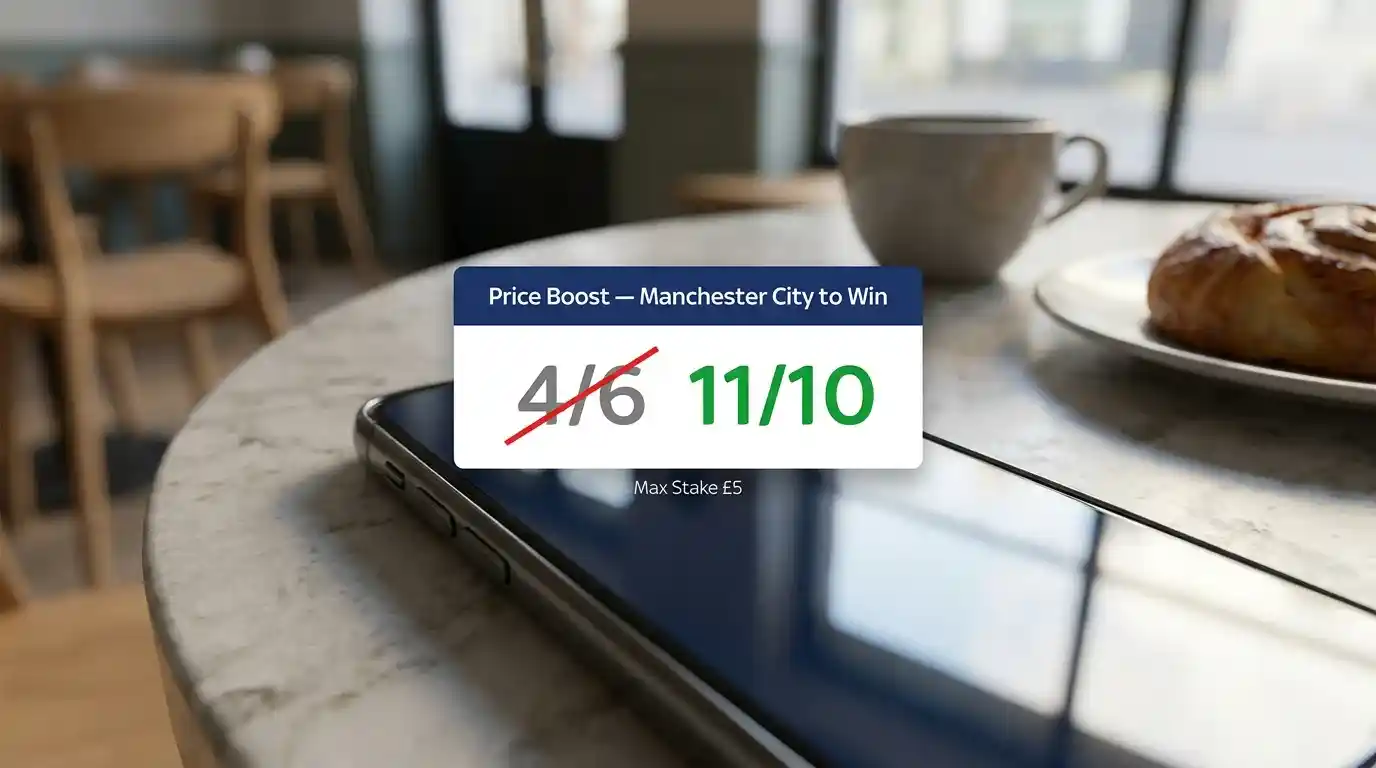
The mechanic is straightforward. The operator takes a market they know punters want — say, Manchester City to win their next league match, originally priced at 4/6 — and they boost it to evens, or to 11/10, for a limited number of customers and a limited maximum stake. The face value of the boost is the difference between the original implied probability and the new implied probability, applied to the maximum stake. The cost to the operator is real but bounded.
What an operator gains from the boost is twofold. First, the marketing visibility — a “boosted” tile on the home screen sells more general turnover than the boost itself costs, because customers who land on the boost frequently place additional, fully-priced bets in the same session. Second, the operator builds behavioural data on customer responsiveness, which feeds future segmentation. A boost is therefore not so much a discount as a promotional investment with a measurable rate of return on activated accounts.
If you want a deeper read on enhanced prices on a per-fixture basis, including the specific case of Best Odds Guaranteed on football outrights, there is a longer treatment in Best Odds Guaranteed on football at UK bookmakers — the difference between BOG and a price boost matters more than most punters realise, because the two operate on completely different settlement mechanics.
Three rules of thumb on boosts. Rule one: the maximum stake matters more than the boosted price, because the maximum stake bounds the maximum dollar value of the boost. A boost from 4/6 to 11/10 capped at five pounds is worth a few pence of expected value. Rule two: boosts that require an opt-in token tend to be more generous than boosts that are open to all customers, because the opt-in funnel costs the operator data they value. Rule three: a boosted price always reads from the operator’s own original price, not from the market-wide consensus price, so a boost from a deliberately conservative starting price can still leave the boosted line worse than the sharp market price at a competing operator.
Wagering, turnover and the rollover trap
Wagering is the single most expensive clause in any UK football welcome offer, and the reason most casino bonuses outside the football vertical end up worth a fraction of their headline. Football welcome offers in the UK use lighter wagering than casino bonuses, but a lighter clause is not the same as no clause.
Wagering — also called rollover, playthrough or turnover requirement — means that any winnings from your free bet token must be staked through the operator a set number of times before they can be withdrawn as cash. “1 × stake” rollover, the most common UK football clause, means you must stake the winnings once through the operator’s sportsbook before withdrawal. That is the friendliest version. “5 × winnings” wagering on a casino bonus means staking five times the winnings, which sounds reasonable until you do the maths.
The trap with wagering is that every leg of the rollover sits inside the operator’s margin. If the average overround on a UK football match-result market is around five to seven percent on the Premier League and rises into double digits on lower leagues, then each pound staked through the operator is expected to return less than a pound in the long run. Stake winnings once through that margin and the expected loss is small. Stake them five times and the expected loss can wipe out most of the bonus’s nominal value.
The minimum odds clause inside the wagering is the second trap. A “1 × stake at minimum 1/2” rollover means each leg of the playthrough must be priced at 1.50 in decimal or higher. Combined with the operator’s margin, this forces you to take bets you might not otherwise take, which is the whole behavioural point of the clause. Wagering is not about giving you something to do with the winnings — it is about giving the operator a structured window to recapture margin from the customer.
The clean way to handle wagering on a UK football welcome offer is to assume the rollover will cost you the operator’s margin times the multiplier on the winnings, and to discount the face value of the bonus accordingly. If a £30 free bet has a 1× rollover at a 6 percent average overround, the expected cost of meeting the wagering is somewhere around £1.80 on full winnings — small relative to the bonus, but real, and worth knowing before you accept the token.
The January 2025 opt-in rule: what changed for promo emails
I remember the meeting where we were briefed on the new opt-in regime, in late 2024, and the immediate question round the table was whether the rule would survive the year. It has survived the year, it has been enforced, and it has reshaped the way every UK football operator markets to new customers.
The rule, effective from 17 January 2025 under the Gambling Commission’s licence conditions, requires UK remote gambling operators — bookmakers included, lotteries excluded — to obtain granular opt-in consent from customers before sending direct marketing. “Granular” is the operative word: an operator can no longer ask for a single consent to receive any kind of marketing on any channel. Customers must be given the choice to opt in or out by product type — sportsbook, casino, bingo, exchange — and by channel — email, SMS, push notification, in-app message. The default for a new account is no marketing, full stop.
The practical effect on welcome offers is twofold. First, the welcome flow at every UK operator now includes a consent step that did not exist before. You will be asked, at registration or shortly afterwards, whether you want to hear about football promotions by email, by push, by SMS — and you can say no to one channel and yes to another. Second, operators have re-engineered their welcome offers to surface promotional value during the registration session itself, because they can no longer assume they will reach you later with a follow-up email about the next promotion.
Grainne Hurst, the chief executive of the Betting and Gaming Council, has been blunt on the broader trajectory of UK regulation: if the regulated sector becomes harder to use or less competitive, customers will not stop betting, they will simply go elsewhere — which is why she argues that any new friction must be genuinely frictionless, or it pushes customers to the unregulated market. The opt-in rule is a quieter example of the same dynamic. It is meant to be frictionless from the customer side, and on the whole it is, but it places the entire weight of promotional value onto the moment of registration in a way that did not previously exist.
For you as a punter, the practical instruction is short. Read the consent step carefully when you sign up for a new UK football account. Opt in only to the channels you actually want. Opt-out is no longer the default behaviour of operators because it is now the regulatory baseline, and the only way to receive promotional follow-ups is by explicit consent — which is a control you should use deliberately, not absent-mindedly.

A pre-claim checklist for any UK football welcome offer
I have built and rebuilt this checklist a dozen times over twelve years on a trading floor, and the current version is the shortest it has ever been. Six items, each meant to take less than thirty seconds to verify, designed to keep you out of the categories of customers who write angry posts on Reddit two weeks after registration.
Item one: confirm the operator is licensed by the UK Gambling Commission. The licence number sits in the footer of every legitimate UK gambling site. If the footer shows a Curaçao or Anjouan licence instead, you are not on a UKGC-regulated site and the consumer protections under UK law do not apply. This is non-negotiable and takes ten seconds.
Item two: read the minimum odds floor on the qualifying bet, and read the excluded markets list. If the minimum odds are 1/1 (2.00) or lower, the offer is mainstream. If they are 1/2 (1.50), the offer is more punter-friendly. If the excluded markets list runs to more than half a screen, treat that as a warning sign.
Item three: identify whether the reward is a token, a cash credit or stake-returned free bets. Tokens are the default. Cash credit is unusual and valuable. Stake-returned free bets are the friendliest format of token.
Item four: read the wagering clause on the winnings. “No wagering” or “1× stake” is the friendliest. “5× winnings” or above is a casino-style clause that has no business sitting on a football welcome offer, and if you see it, walk away.
Item five: check the time window. Most UK football welcome offers expire in seven, fourteen or thirty days from registration. The longer window is friendlier. Anything below seven days is hostile to anyone who is not registering specifically to chase the offer.
Item six: cap your own expectation. On a £30 face-value welcome offer with a standard 1× rollover at 1/2 minimum odds, my own internal benchmark on expected withdrawable cash sits between fifty and seventy percent of face value for the median punter, depending on the operator. If you expect the headline, you will be disappointed. If you expect half to two-thirds, you will be roughly correct on average — and you can decide whether that is worth the time investment.

Reading the offers before they read you
The welcome offer is the moment where the entire economic relationship between a UK football operator and a new customer is set. Everything that follows — the boosts, the acca insurance, the in-play promotions, the ongoing reload offers — is calibrated against the customer behaviour the operator observes in the first thirty days of the account, and that behaviour is heavily shaped by how the welcome offer was structured and how you reacted to it.
The Gambling Commission’s industry data for April 2024 to March 2025 shows £2.6 billion of remote sports betting gross gambling yield in Great Britain, of which £1.3 billion came from football alone. That £1.3 billion includes every welcome offer, every free bet token, every price boost, every wagering clause and every customer who walked away without claiming the bonus. The number you place on the qualifying bet at registration is a single drop in that ocean, but the structure that channels it is the same structure that produces the ocean.
The work I have outlined here is, deliberately, work you do before you bet. Once the qualifying stake is placed, your control over the offer is finished — everything after that runs on the operator’s terms. Five minutes of careful reading before you click “Deposit” is worth more, on average, than five hours of strategy work after the token has arrived.
Welcome offers are not the enemy. They are a real promotion with a real cost to the operator, and on the right terms they can give a thoughtful punter a small, defensible edge in a market where defensible edges are rare. But the headline is decoration. The structure is the offer. Read the structure, and the offer will read you back honestly — which is the most you can ask of any commercial product, in football betting or anywhere else.
Frequently asked questions
Why do most UK football free bets exclude even-money selections like 1/1 (2.00)?
Most UK football welcome offers include even money in the qualifying-bet floor, not exclude it — the minimum odds requirement is typically 1/1 or 4/5. Where evens are explicitly excluded, it tends to be on tokens used for ongoing weekly promotions rather than the welcome offer itself, and the reason is variance: even-money outcomes settle close to a coin flip, which lets a token holder lock in expected value too cheaply. Operators usually nudge the minimum upward — sometimes to 6/4 or higher on a token-only promotion — to force the punter onto markets where the operator"s margin has more room to work.
Does the free-bet stake count towards my winnings on a successful punt?
No, almost never on a UK football welcome offer. A free bet token of £20 placed on an evens market and won returns £20 of winnings only, not £40. The stake is consumed by the token rather than returned with the payout. There is a separate format called "stake-returned free bets" that behaves exactly like cash, but that format is rare on welcome offers and far more common on ongoing customer promotions. Always check the offer terms for the phrase "stake returned" — its absence means the stake will not come back to your balance when the token wins.
What does "1 × stake" rollover mean on a football bonus?
It means that any winnings generated from the free bet token must be staked once through the operator"s sportsbook, at the operator"s minimum-odds floor for the rollover, before those winnings can be withdrawn as cash. So if a £30 free bet returns £60 in winnings, the customer must place sportsbook bets totalling £60 of stake on qualifying markets before the £60 becomes withdrawable. The expected cost of meeting a 1× rollover is small — roughly the operator"s average overround on the markets used — but it is not zero, and the rollover must be completed within the offer"s time window or the winnings are forfeited.
After the 2025 opt-in rules, will I still get promo emails from my UK bookmaker?
Only if you actively opt in. Since 17 January 2025, UK remote bookmakers have been required to obtain granular opt-in consent before sending direct marketing — separately by product type (sportsbook, casino, bingo) and by channel (email, SMS, push notification). A new account defaults to no marketing on any channel until the customer ticks the relevant boxes. If you registered before January 2025 and have not reviewed your preferences since, your operator will have asked you to reconfirm — and if you did not respond, marketing on that channel will have been switched off.
This material was created by the Pitchledger team.
