


Why the Premier League sets the tone for every UK football market
Walk into any UK bookmaker’s trading room on a Saturday at ten in the morning and look at the screens. The Premier League card is in the centre, the Championship and lower English leagues sit to one side, the European fixtures sit to the other. The whole room is calibrated against the Premier League card, and not just because the volume is there. The Premier League is the price reference for every other football market the operator runs. Get the Premier League right and the rest of the book follows. Get the Premier League wrong and the whole desk has a long afternoon.
I have spent twelve years pricing this league for British books — first as a junior trader assigned to the lower-volume midweek fixtures, then as a senior on the Saturday three o’clock card, then as a margin analyst doing the after-the-fact work of seeing where the desk made money and where it gave it away. The view from the inside has not changed in those twelve years on one core point: the Premier League is the most efficient football betting market in the world. The prices are sharp, the margin pressure is real, and the punter who walks into the market expecting easy edge on the title outright will leave it disappointed.
The Gambling Commission’s industry data for April 2024 to March 2025 puts UK remote sports betting at £2.6 billion of gross gambling yield, of which £1.3 billion came from football alone. The Premier League is the largest single component of that £1.3 billion by a comfortable margin — exact splits are not published, but the trading-floor view across the major operators is that Premier League turnover accounts for somewhere between forty and fifty-five percent of all UK football betting volume in a given season. Everything else that follows in this article — the outright markets, the weekly fixture cycle, the sponsorship economics, the data ecosystem — is shaped by that single concentration of attention.
What I want to do in this piece is show you how the Premier League market actually works from the desk side. How the margin gets set, which markets carry sharp prices and which carry recreational prices, why derbies move differently from regular fixtures, what the 2026/27 sponsorship reset actually changes for the punter, and how to use the operator data ecosystem to your advantage when picking a Premier League book. None of this is a list of bookmakers. All of it is the analytical foundation for choosing one.
Premier League turnover and the tighter margin it commands
Margin pressure in the Premier League market is the single fact that separates this league from every other football competition on a UK book. The desks that price Manchester City versus Arsenal on a Saturday afternoon are competing against every other UK operator pricing the same fixture, and the competition is fierce because the volume is enormous. Tight margin is not a courtesy — it is the price of being a credible operator in the most-watched football market in Britain.
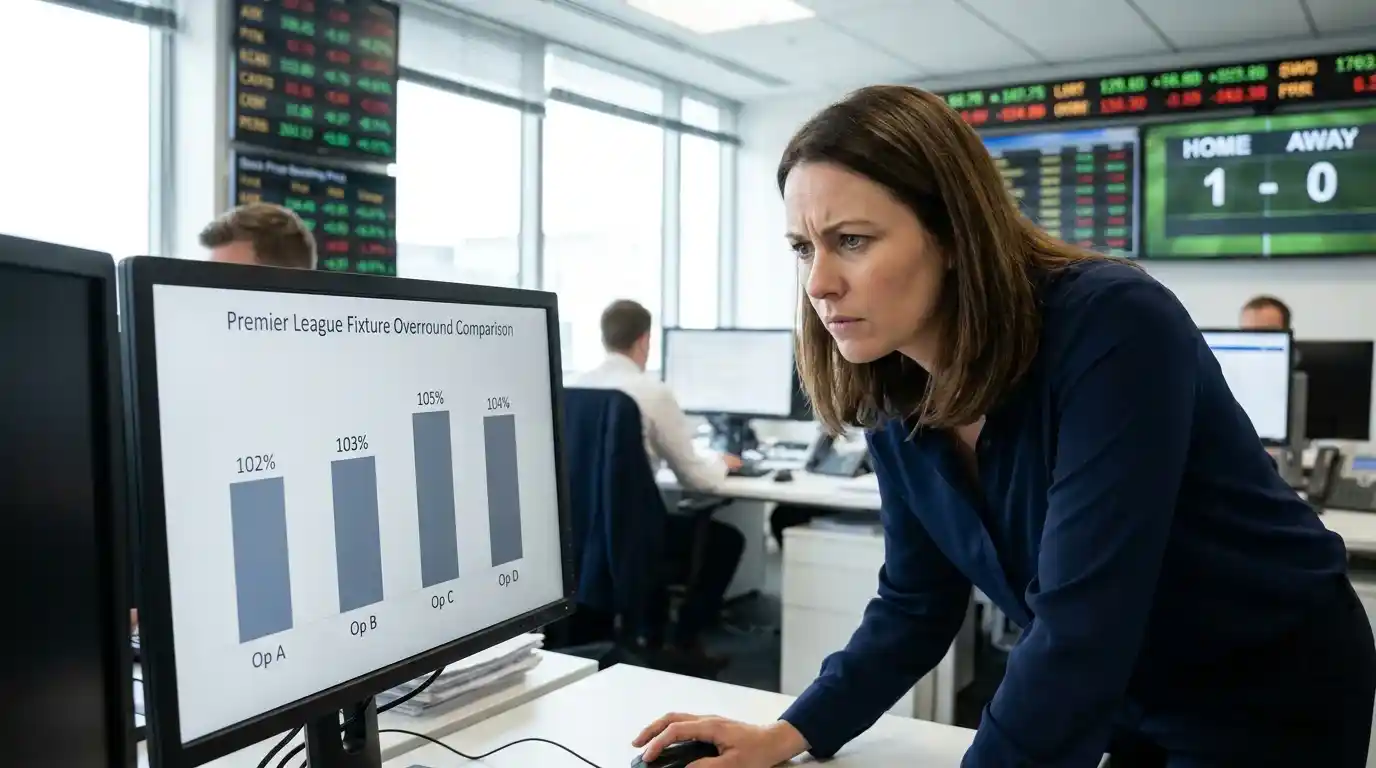
The typical pre-match match-result overround on a Premier League fixture across the major UK operators sits between 102 and 106 percent in 2026, depending on operator and depending on the fixture’s profile. On a Manchester City home fixture against a mid-table opponent, the margin sits closer to 102 percent — the market is so heavily traded that any operator running materially above that level will see customers shop the price elsewhere and lose flow on the rest of the slip. On a relegation-zone Saturday three o’clock fixture between two clubs with thinner public interest, the margin can drift up to 105 or 106 percent, because the price-comparison flow is lighter and the operator has more room to take a slightly wider line.
The Adthena PPC data from early 2026 is consistent with this pattern. William Hill captured 37.83 percent of UK sports betting click-through share on search advertising, with bet365 at 16.2 percent. The two operators with the largest share are also the two operators running the tightest Premier League margins on the headline fixtures, and the relationship is not accidental — the click-through dominance is partly a function of price competitiveness, and the price competitiveness reinforces the click-through dominance through the obvious feedback loop.
What this means for a Premier League punter is that the price you see on a major UK operator on a top-six fixture is, almost always, very close to the consensus market price across the regulated sector. The room for finding a substantially better price by switching operators on a top-six match-result single is small. Where the room exists is in the secondary markets — Asian handicaps, total goals, player props, half-time results — where the margin pressure is less even and the operator-to-operator spread is wider.
The corollary is that finding edge in the Premier League single match-result market requires either a model that meaningfully beats the consensus or information that the market has not yet absorbed. Both are difficult. The realistic edge for the median UK punter sits in the secondary markets, in the in-play product, or in the Bet Builder layer that combines multiple legs into a single slip — none of which appears in the headline match-result line that draws most of the volume.
Outright markets: title, top four, relegation
Outright markets are where Premier League pricing diverges most sharply from match markets, and where the punter’s relationship with the operator looks least like a single transaction and most like a season-long position. The mechanics deserve more attention than they usually get.
The title market is priced from the start of the season through the final fixture, and the price on a leading club moves slowly through August and September before accelerating from October onward as the table forms. A title-favourite priced at 6/4 in early August will typically have moved either inside 5/4 or outside 7/4 by Christmas, depending on form. The mechanism is straightforward: each fixture week adds new information to the model, the model reprices the title probability, and the operator’s quoted price tracks the model. What is less straightforward is the operator-by-operator variation, which on outright markets is sometimes meaningful — a club priced at 11/4 at one major UK operator may sit at 3/1 at another, and the difference is large enough that a punter holding a position should be alert to it.
The top-four market — sometimes called the Champions League qualification market — is the second most heavily traded outright, and the pricing structure has shifted permanently with the change to the UEFA league phase. The competition for top-five places (the additional Champions League slot earned by English performance in European coefficient) reshaped the upper-end probability distribution in a way that operator models have largely absorbed, but the price moves during the second half of the season are still meaningfully sharper than they were five years ago. If you want to think about how the European competition layer interacts with domestic outrights, the more detailed treatment is in Champions League betting markets at UK bookmakers, where the league-phase mechanics are unpacked in more depth.
The relegation market sits at the other end of the table and behaves very differently from the title or top-four markets. The probability of relegation is concentrated on a relatively small number of clubs — typically four to six candidates from October onward — and the pricing is volatile, sometimes moving five or ten percentage points of implied probability on a single result. Operator margin on the relegation market is wider than on the title market, partly because turnover is lower and partly because the model uncertainty around the lower-table teams is higher.
Two structural points on outright pricing. First, the prices firm up most aggressively after international breaks, because the model has absorbed two weekends of evidence with no Premier League fixtures and is recalibrating from a stable base. Second, the prices on long-shot positions — a tenth-placed club to win the title in March, for example — are typically loose for the simple reason that almost no money flows into them and the operator does not need to compete to publish a sharp number. The looseness is not edge, because the implied probability remains small, but it is a visible feature of the market.

The weekly fixture cycle: openers, midweek and Sunday late kick-off
The seven-day Premier League cycle has its own rhythm, and the price discovery follows it. Operators do not price all ten fixtures of a weekend in the same way at the same time, and the punter who shops the same operator’s prices on Tuesday morning and Friday afternoon is looking at two different products.
Tuesday and Wednesday are the price-discovery days. The first prices on the upcoming weekend go up Monday or Tuesday, and they move quickly through the first forty-eight hours as the market absorbs sharp money, injury news, and any tactical signals from training reports. The prices on Tuesday are softer in the technical sense — they are the operator’s initial position, before the consensus market has fully formed — and the operator’s margin sits visibly inside the spread between the largest UK books.
Thursday and Friday are the consensus days. By Friday afternoon, the prices across the major UK operators have converged tightly on most fixtures, and the visible margin spread has narrowed. This is the day when shopping prices across operators yields the smallest gain on top-six fixtures, and the largest gain only on secondary markets where the convergence is slower.
Saturday morning is the sharpening period. Team news arrives around an hour and a half before kick-off, and the prices on every market that depends on lineups — match result, total goals, player props, Asian handicaps — adjust immediately. A punter who places a bet on the Saturday three o’clock card at nine in the morning is betting on a different price than the punter who places the same bet at one in the afternoon, and the difference is rarely in the early punter’s favour on a heavily-traded fixture.
The midweek slate — usually Tuesday and Wednesday fixtures — has a compressed version of the same cycle. The fixtures are priced up the weekend before, prices move through Monday and into Tuesday morning, and the team-news adjustment happens on the day of the fixture. Volume on midweek is materially lower than on the Saturday card, and the operator margin tends to drift slightly wider on midweek fixtures as a result.
The Sunday late kick-off is the anomaly. By the time it kicks off, Saturday’s results have already moved the title, top-four and relegation pictures, and the late kick-off price has absorbed all of that. It is also the fixture where in-play volume per minute peaks on the weekend, because it sits without competition from other matches and concentrates the entire late-Sunday football audience on a single fixture. The pre-match prices on the Sunday late kick-off are typically the sharpest of the weekend.

How derbies and “six-pointers” are priced differently
A derby is not a normal Premier League fixture, and the pricing reflects that — but not in the direction most punters assume. The operator does not move the price aggressively toward the visible favourite in a derby. The operator moves the price aggressively toward the draw, because derbies historically produce more draws and lower-scoring fixtures than the rest of the league, and the model has to capture that distortion.
The visible margin on a derby tends to be tight, similar to the top-six fixtures more generally, because the volume is enormous. The implied probability of the draw, however, sits noticeably higher than it would in a non-derby fixture between the same two clubs. A North London derby between Arsenal and Tottenham at White Hart Lane will typically price the draw at around 11/4, whereas a fixture between the same two clubs at a neutral venue (which does not exist, but hypothetically) would price the draw closer to 3/1 or 10/3. The difference is the derby effect baked into the model.
The “six-pointer” — a fixture between two clubs competing for the same league position, where a swing of six points in the standings is in play — operates on similar pricing logic but for different reasons. The model treats six-pointers as higher-variance fixtures because the motivational and tactical context is non-standard. The price on the draw tends to drift higher, the price on a low-scoring outcome tends to be shorter, and the over-2.5 goals market tends to price slightly tighter than the same teams’ usual fixture. The desk knows this; the punter often does not, and the value is sometimes in betting against the assumed match narrative.
Two cautions. First, the derby effect is real in aggregate across many fixtures, but it does not necessarily apply to every individual derby — the most recent five derbies in the Premier League have not all produced draws or low-scoring outcomes, and a punter applying the aggregate rule to a single fixture is committing the same statistical error the model is built to avoid. Second, the six-pointer label is sometimes applied to fixtures that are not actually six-pointers in the strict league-position sense, and the punter should check the table standings before assuming the pricing has been adjusted for the six-pointer effect.
The 2026/27 shirt-sponsorship reset and what it means for the punter
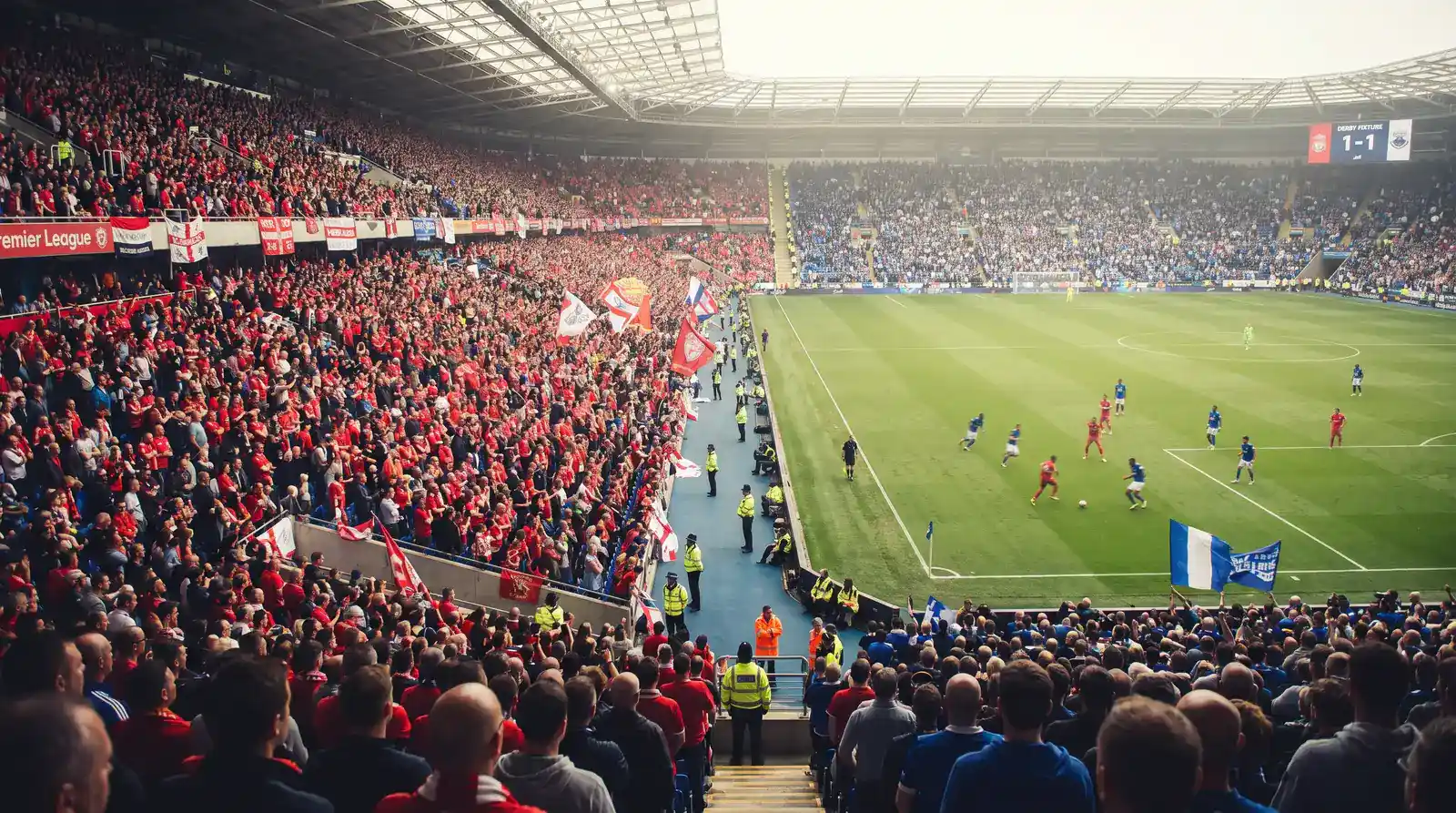
The voluntary ban on front-of-shirt gambling sponsorship in the Premier League comes into effect from the start of the 2026/27 season, and the operational details of the change are worth understanding even if you have no direct interest in the commercial economics of the clubs. The change shifts the relationship between the regulated UK gambling industry and the league it has supported for two decades, and the implications for punter behaviour are subtle but real.
In the 2025/26 season, eleven of the twenty Premier League clubs carried a gambling brand as their front-of-shirt sponsor. The combined commercial value of those sponsorships, across the eleven clubs, sat in the tens of millions of pounds in annual revenue terms, and the clubs’ commercial revenues for 2024/25 were £2.37 billion in aggregate — up 10 percent year-on-year. The front-of-shirt deals are a meaningful component of that aggregate.
When those deals are replaced with non-gambling sponsorships from the 2026/27 season, the clubs face a documented revenue gap. Sean Connell, who edits The Sponsor, recently put the gap concretely: EPL clubs with gambling sponsors stand to lose, on average, 38 percent of their front-of-shirt value if forced to replace these deals with non-gambling brands. The cumulative cost across the eleven affected clubs has been estimated at around £80 million per season — a figure that has circulated through The Guardian and the trade press since early 2026.
What this changes for the punter is twofold. First, the visible marketing footprint of gambling brands in the Premier League is going to shrink, and the relationship between the operator and the club’s identity is going to weaken. Clubs that have been associated with specific gambling brands for years — through the front-of-shirt and through the marketing partnerships that accompany it — will be associated with different categories of brand, and the cross-promotional offers that have operated between operator and club will need to find different anchoring points.
Second, the EFL retains its title-sponsorship deal with Sky Bet until 2029, which means the lower divisions remain commercially intertwined with the gambling sector during the same period that the Premier League is moving away from it. The asymmetry produces a strange picture: a UK punter watching a Saturday three o’clock match on a streaming service may see a Premier League fixture without any front-of-shirt gambling presence, immediately followed by an EFL Championship fixture with the Sky Bet logo on every static board around the ground.
The political backdrop to the ban is not new. Carolyn Harris MP, the chair of the Gambling-Related Harms All-Party Parliamentary Group, has argued for years that shirt sponsorship by betting companies normalises gambling for children, and that gambling sponsorship in sport in all its forms should — and would — be banned. The 2026/27 reset is not the end of that argument; it is one milestone in a longer regulatory debate that is likely to continue through the second half of the decade.
The direct effect on Premier League odds and pricing is, in honest analytical terms, near zero. The shirt-sponsorship change does not alter the operator’s model inputs, does not change the data feed, does not move the consensus market price. The indirect effect is more interesting: with the marketing channel closed, operators will compete on product and price rather than on visible association with clubs, which over the medium term tends to favour the punter through tighter pricing rather than through bigger logos.
Where the sharp Premier League price actually forms
The sharp Premier League price does not form on the operator’s own pricing engine. It forms in the market, across a small number of professional money providers and exchange flows, and the operator engines then track that consensus. Understanding where the sharp price actually lives helps you read the operator-quoted prices honestly.
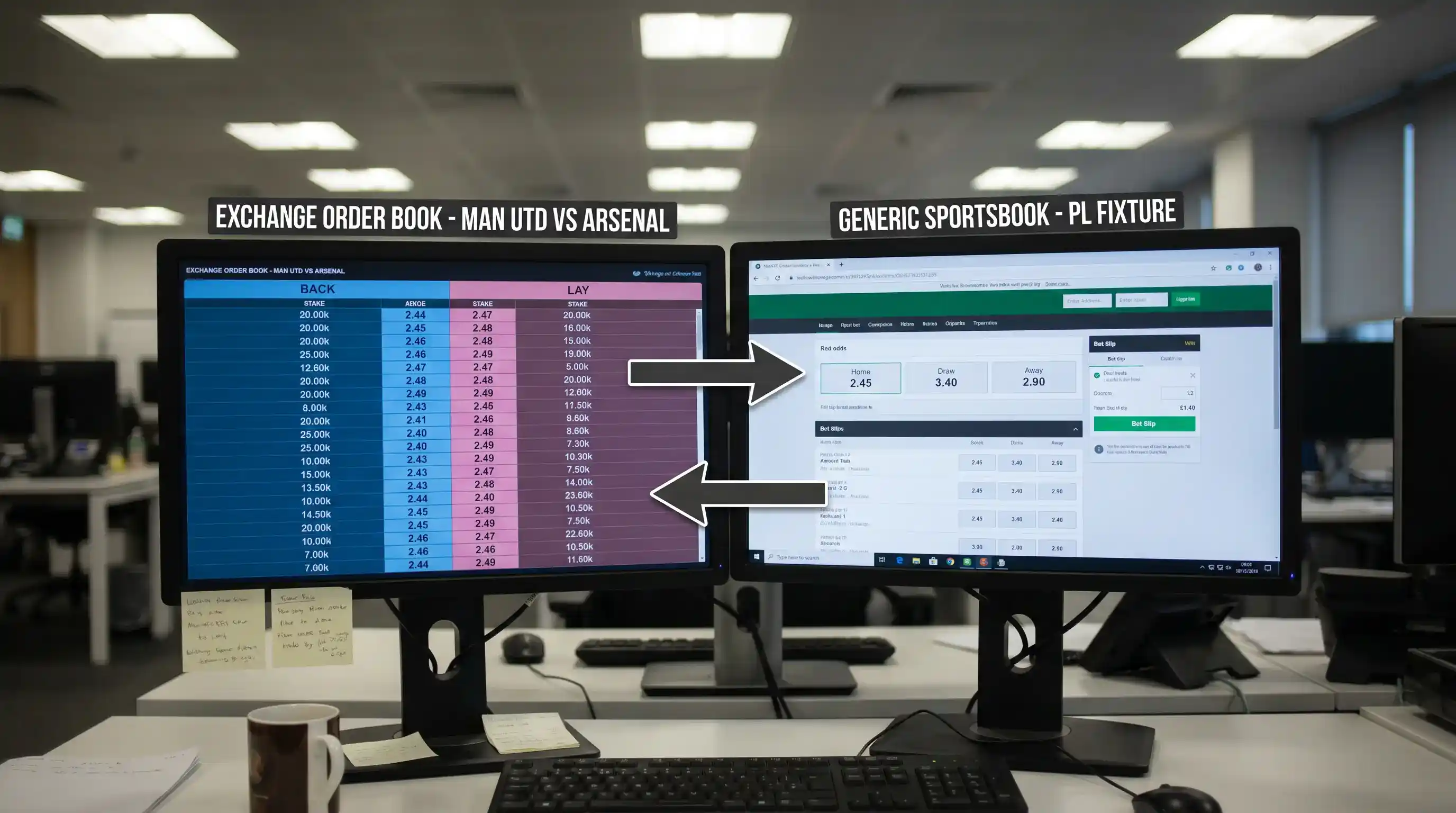
The exchange — Betfair, predominantly, in the UK market — is the visible piece of the consensus. The traded volume on a Premier League match result by kick-off can be substantial on a top-six fixture, and the prices on the back and lay sides represent the actual market clearing price for that risk. Operator-quoted fixed-odds prices on the same fixture are calibrated against the exchange price plus a margin component on each side. A well-run book is rarely more than two or three percentage points of implied probability away from the exchange consensus on a top-six fixture.
The Asian markets — particularly the offshore Asian handicap market that prices the same fixtures with a different overround structure — are the less-visible piece of the consensus. The Asian handicap price on a Premier League match is often available to UK punters through the regulated UK operators that offer it, but the sharper prices live in the Asian wholesale market that supplies sharper money providers globally. Operators on the UK side reference the Asian consensus and adjust their handicaps accordingly.
The data ecosystem that feeds the model is the third piece. Sportradar, Stats Perform and Genius Sports supply event data, expected goals models, lineup data, injury feeds and live in-play data to almost every major UK operator. The data is broadly identical across operators, which is one reason the consensus price converges so tightly through the run-up to kick-off. The difference between operators is not in the data — it is in the calibration of the model that consumes the data.
The active monthly account base across the largest UK operators reached 13.5 million by March 2025, according to the Gambling Commission’s operator data to that quarter, and the per-fixture turnover those accounts generate is the largest single sink of liquidity into the Premier League market in any given week. The liquidity supports the tight margins, which support the convergence, which feeds back into the liquidity.
Picking a Premier League-focused bookmaker
If you bet primarily on the Premier League, the criteria for picking a bookmaker differ from the generic “best bookmaker overall” criteria, and the difference is worth being explicit about. There are four things that matter for a Premier League-focused punter, and most of the marketing noise around UK bookmaker comparisons can be ignored if you focus on these four.
The first is consensus pricing on the headline markets. A Premier League punter needs the operator to be price-competitive on match result, both teams to score, over-under 2.5 goals and Asian handicap on the top-six fixtures. The operators in the top of the Adthena click-through data — William Hill at 37.83 percent share, bet365 at 16.2 percent — are competitive in this segment by definition. The second-tier UK operators are sometimes competitive on the most-traded markets and sometimes meaningfully wider — the test is to compare the same fixture across three or four operators on a Friday afternoon and see where the spread sits.
The second is depth on secondary markets. Player props, alternative handicap lines, half-time scorelines, scorecast and wincast hybrids — these markets carry wider margins than the headline markets, but they also carry the bulk of the punter’s potential edge through the season. An operator that runs deep player-prop menus on every Premier League fixture is more valuable for a Premier League-focused punter than an operator with a tight match-result price but a thin secondary menu.
The third is in-play coverage. Premier League in-play is the operator’s premium product, and the operators with the deepest in-play menus, the lowest in-play latency and the cleanest void rules are materially better products for a Premier League punter than the operators running thinner in-play offerings. The test here is to spend ten minutes watching the in-play product during a Premier League match without betting — the price-movement pattern, the suspension behaviour and the bet-confirmation latency become visible quickly.
The fourth is the responsible-play tools and the operator’s compliance with the broader regulatory framework. Every UK Gambling Commission-licensed operator must provide deposit limits, time-outs, self-exclusion and Financial Risk Assessment triggers in line with the 2025 rule changes. The compliance is not optional, and the variation between operators is more about user experience than about the existence of the tools. An operator that surfaces the responsible-play tools cleanly and lets you set deposit limits without three layers of menu navigation is a better product for a long-term Premier League punter than an operator that buries the same tools four screens deep.

How the league reads from the desk side
The Premier League is the most efficient football market in the world, and the British punter has the rare advantage of betting into a regulated market where that efficiency is enforced by competition rather than by mandate. The margins are tight because eight or ten operators are competing for the same flow. The data ecosystem is deep because the operators have invested in it. The product is rich because the volume justifies the investment.
None of this is good news for the punter who wants easy edge. The market does not hand out edge to punters who bring the same model the operator already runs. The market does hand out edge — modest but real — to punters who pay attention to the secondary markets, who shop prices across operators rather than defaulting to one, who use the in-play product carefully rather than reactively, and who treat the consensus price as the benchmark against which to evaluate any quoted line.
The 2026/27 sponsorship reset is the visible change in the league’s commercial structure this year, but the underlying market structure is unchanged. The desks still price the Premier League first and let everything else follow. The punter who reads the desk-side logic accurately will find a small, defensible edge over time. The punter who reads the marketing and not the maths will find the headline number disappears faster than the season does.
Frequently asked questions
Which UK bookmaker typically offers the tightest Premier League outright margin?
The two operators with the largest UK click-through share — William Hill at 37.83 percent and bet365 at 16.2 percent in early 2026 — are also the two that consistently run the tightest outright margins on the Premier League title, top-four and relegation markets. The tightness is a function of volume: large active customer bases force the operator to remain price-competitive against exchange consensus, because any meaningful divergence is exploited by the price-shopping flow. Second-tier UK operators sometimes match the leaders on individual outright markets but rarely across all three, and the spread tends to widen on niche outrights — top goalscorer, manager-of-the-season — where the leaders" volume advantage is smaller.
Why do prices on a Premier League draw move so little in the final 24 hours?
The draw is the most stable component of the match-result book in the final 24 hours before kick-off, because it absorbs less of the team-news adjustment than the win prices do. When team news arrives 75 to 90 minutes before kick-off, the prices on the favourite and the underdog can both move sharply on a key absence or return, but the draw price typically moves by a fraction of either — sometimes 2 or 3 percentage points of implied probability while the win prices move 5 or 7 points. The reason is structural: a missing key player tends to shift probability between win outcomes rather than into or out of the draw outcome, because the draw scenario is less sensitive to lineup composition than the outright win scenarios.
Will the 2026/27 shirt-sponsorship change affect Premier League odds directly?
No, not in any direct way. The shirt-sponsorship change is a commercial restructuring between clubs and gambling brands; it does not change the data inputs the operator models consume, the consensus exchange price, or the regulatory framework that governs how operators price their books. The indirect effects are real but slow: with the front-of-shirt marketing channel closed to gambling brands in the Premier League, operators will compete more visibly on product and price than on club association, which over the medium term tends to favour the punter through marginally tighter pricing rather than through bigger sponsorship visibility around stadiums.
This material was created by the Pitchledger team.
