

What “in-play” means in a Premier League context
The first time I traded a live Premier League match for a UK book, in 2014, the entire in-play product was four markets and a refreshing browser page. The next-goal market was the entire show. Eleven years later I have watched the same fixture run with sixty live markets open simultaneously, suspending and reopening on every dangerous attack, repriced in real time from a model fed by event data delivered at sub-second latency. The product has changed completely. The punter’s relationship with it has not changed enough.
In-play is the term every UK bookmaker uses for football betting that takes place after kick-off. Sometimes you will see it called live betting, sometimes in-game, but the language settled into “in-play” on UK apps a decade ago and stayed there. The mechanic is simple: the match has started, the result is unknown, the operator continues to price every market they ran before kick-off plus a layer of new markets that only make sense once the ball is moving. The punter can stake until the operator pulls the market for suspension, voids it for a goal or a card or a substitution, or settles it at full-time.
The Gambling Commission’s Wave 4 of the Gambling Survey for Great Britain, conducted between September 2025 and January 2026, found that live football betting is now the single most popular live-betting format in the country. Five percent of all adults in Great Britain placed a live football bet during the survey window, rising to nine percent among men. No other live-betting format — not horse racing, not tennis, not cricket — comes close. Live football is the reason in-play exists as a product category at all on UK sites.
What follows is a working guide to what happens inside a UK in-play football product during the ninety minutes of a Premier League fixture. How the prices move, why the market suspends, how the streaming layer interacts with the betting layer, where the new microbetting products fit in, and — at the end — why live betting requires harder personal risk controls than any other format on the same app. I treat the prices and the mechanics as one thing, because on a modern UK platform they are.
Why live football is Britain’s number-one in-play market
Ask a trader why live football outpolls everything else as a UK in-play product and they will give you a structural answer about scoring rate. Ask a punter and they will give you a behavioural one about the ten-minute attention span. Both are right, and the two answers together explain why no other sport on a British sportsbook generates the in-play turnover football does.
The structural piece comes from the data. Wave 3 of the Gambling Survey for Great Britain, covering July to October 2025, shows that sixteen percent of men in Britain bet during the previous four-week window, compared to four percent of women. Online gambling participation across all adults runs at thirty-nine percent of the population during the same four-week period, dropping to sixteen percent once you strip out the lottery-only segment. The gender gap and the scale of online participation together mean that in-play football lands in front of a customer base that already exists and is already active — the product does not have to recruit, only to convert.
The behavioural piece is more interesting. A football match produces, on average, 2.5 to 3.5 goals at Premier League level, distributed unpredictably across ninety minutes plus stoppage time. That distribution maps neatly onto a sportsbook product that needs to keep a customer engaged through the full event. Every dangerous attack is a potential pricing event. Every booking is a potential market move. Every substitution after the hour mark shifts the implied probability of the late equaliser. The match generates its own attention, and the operator’s job is to convert that attention into a series of small bet decisions.
From the trader’s side this is a goldmine. Live football is a high-frequency, high-engagement product with a margin profile that compounds across the match — a punter who bets the next-goal market five times during a single fixture is exposed to the operator’s overround on every cycle, not just once. From the punter’s side it is a maze. The same product that keeps you engaged through ninety minutes also keeps you reaching for the bet slip at exactly the moments when the price moves are least favourable.
The combination is why in-play turnover at UK operators in football grew faster than pre-match turnover throughout 2024 and 2025, and why every product road map at every major UK sportsbook prioritises in-play features ahead of pre-match upgrades. The market that pays best is the market that gets developed first.
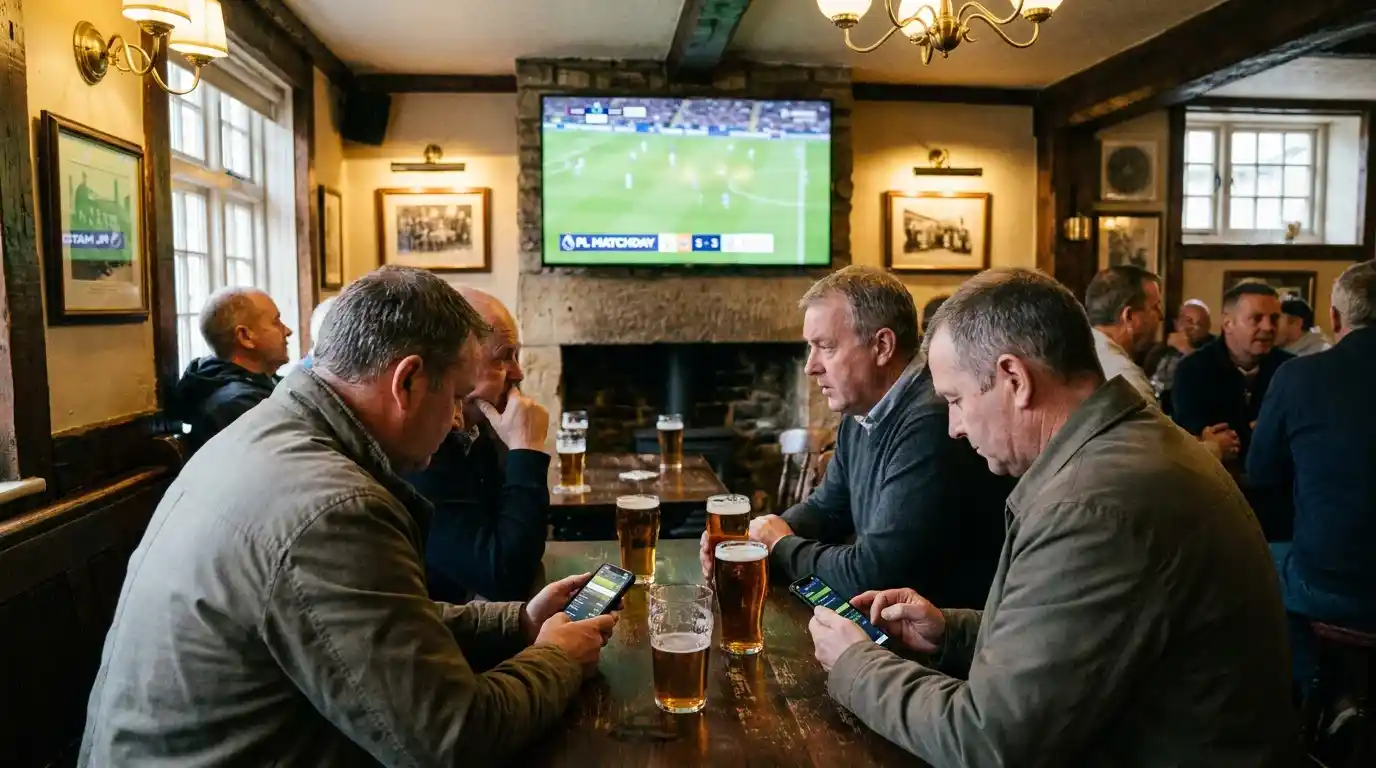
How bookmakers move odds during a live match
The single most useful mental model I can give you for understanding in-play prices is this: a UK in-play football market is a Monte Carlo simulation, run continuously, that updates its inputs every time something happens on the pitch and re-prices everything that depends on those inputs. The price on your screen at the seventy-third minute is not the same product as the price at the seventy-second minute. The model has moved.
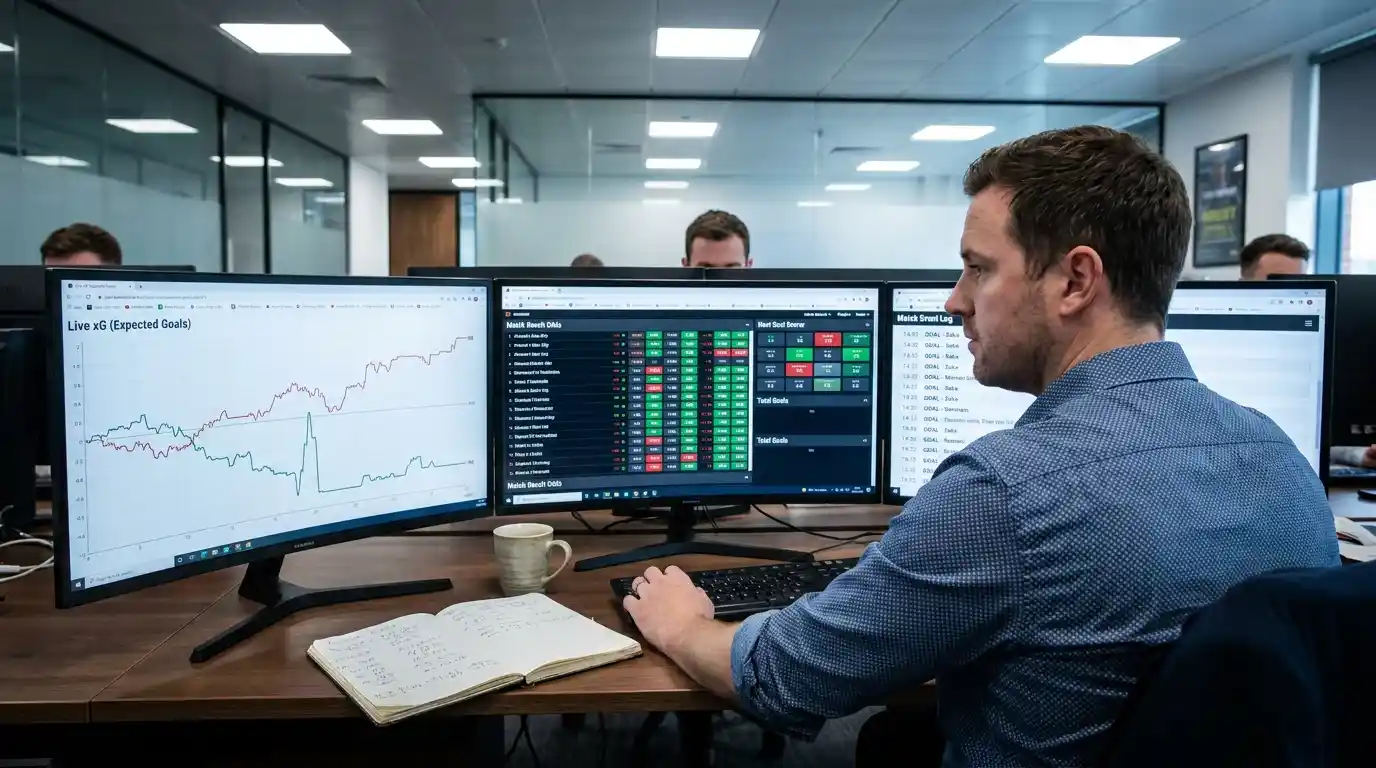
The inputs are minute-by-minute event data: shots, shots on target, corners, possession, expected goals delivered as a live xG figure, dangerous attacks, fouls, cards, substitutions. The data arrives on the operator’s pricing engine from one of a small number of specialised data suppliers — Sportradar, Stats Perform, Genius Sports are the three names that dominate the UK football market — and the engine runs an updated simulation against that data many times per minute. The output is a set of implied probabilities for every market the operator is running, and those probabilities are turned into prices with the operator’s margin added on top.
What this means in practice is that the price you see has a known lag from the event on the pitch. There is data latency from event to engine — typically half a second to two seconds depending on data supplier and feed quality — and there is operator-side latency from engine to your screen. Cumulatively, the price you click in the seventy-fifth minute may be reflecting an event that has just happened on the pitch but has not yet shown up in your live stream. This is the central asymmetry of in-play football betting on a UK platform, and the entire product is built around managing it.
The operator manages the lag by suspending markets at exactly the moments when the lag would be most exploitable: when a dangerous attack is in progress, when a shot has been taken, when a goal looks imminent, when a card is being shown but not yet confirmed. The suspension is the operator’s protection against in-play arbitrage — a customer with a faster information source than the operator’s pricing model could otherwise lock in expected value at every pricing event.
The price moves themselves follow patterns that become visible to anyone who watches enough live football on a UK app. A goal contracts the winning team’s match-result price aggressively and lengthens the losing team’s price symmetrically. A red card moves the price by more than a goal in the early minutes of a match, by roughly the same as a goal in the middle third, and by less than a goal in the final fifteen minutes. A substitution rarely moves the match-result price by much but routinely moves the goalscorer market. Time is a more powerful lever than score on most in-play prices — the match-result price compresses sharply in the final fifteen minutes regardless of the scoreline, because the time available for further events is shrinking.
None of this is opaque. The model is the model, the data is the data, and the prices are the visible output of a process that is technically routine and commercially decisive.
Next goal, next corner, next card: the in-play menu
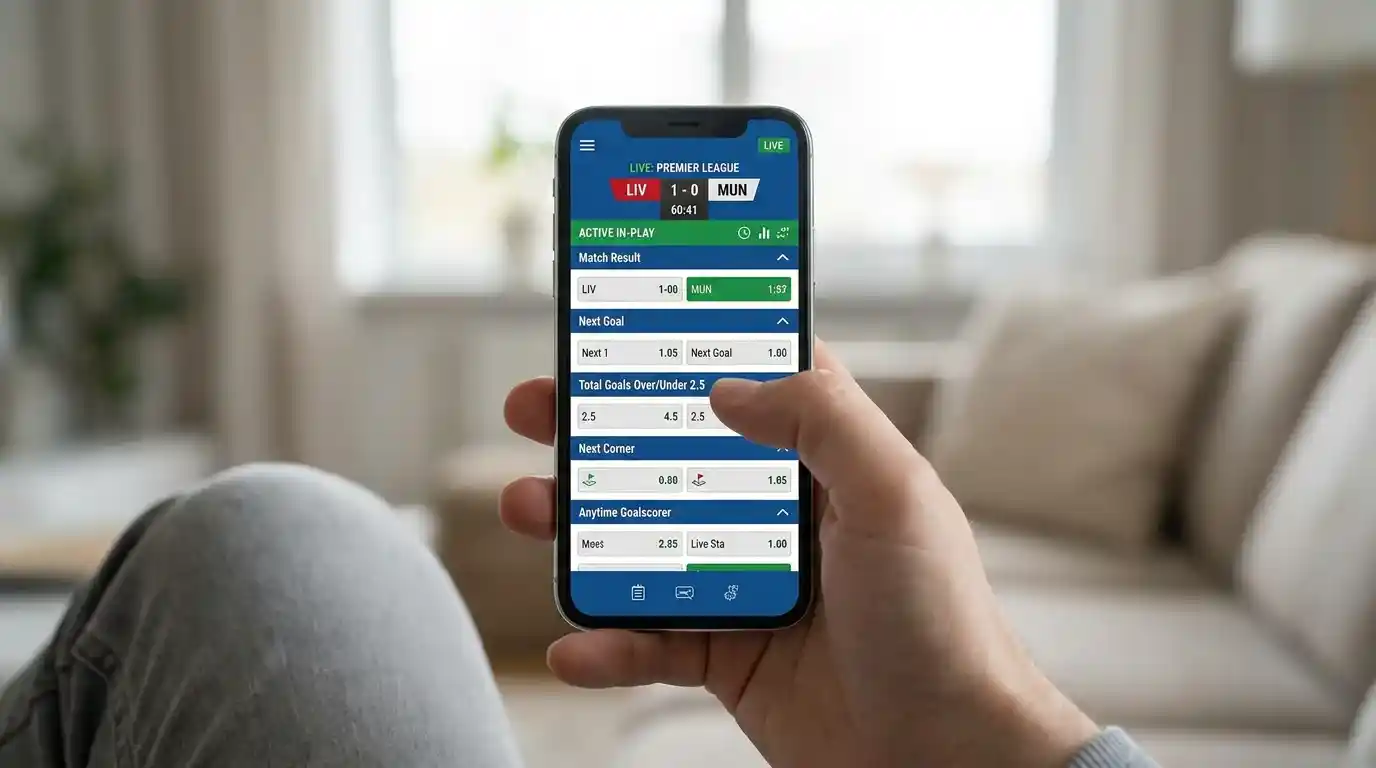
A modern Premier League in-play menu carries between forty and seventy markets at any given moment. Most punters use four or five of them. The other sixty are there for variety, for traders who want to layer positions, and for the price-discovery side of the operator’s product. Let me walk through the markets that actually move volume.
Match result is the spine. The 1X2 market continues to price live through the entire ninety minutes plus stoppage time, suspending around goals and dangerous attacks and reopening once the engine has reset its model. Volume on the live match-result market peaks in two windows: the first fifteen minutes after kick-off, when the pre-match position is being recalibrated against early evidence, and the last fifteen minutes of regulation time, when the implied probability of late goals creates a wide range of plausible outcomes.
Next goal is the second most-traded market and the one where the maths is most punishing. The market prices “next goalscorer team” — home, away, or no further goal — and it reprices around every dangerous attack. The expected value of the next-goal market sits closer to a coin flip than any other live market on a UK platform, which means the operator’s overround sits more comfortably on it. A punter who bets the next-goal market five times across a single fixture is paying the operator’s margin five times.
Total goals and over-under markets reprice continuously around the goalscoring rate the model implies from the remaining time, the current score and the live xG. A 2.5 goals over-under market behaves very differently at 0-0 in the seventieth minute than it does at 1-1 in the fortieth minute, and the prices reflect that. Combined with a half-time over-under, this product range tends to attract the more analytical punter who is reading the xG figure rather than the visible match.
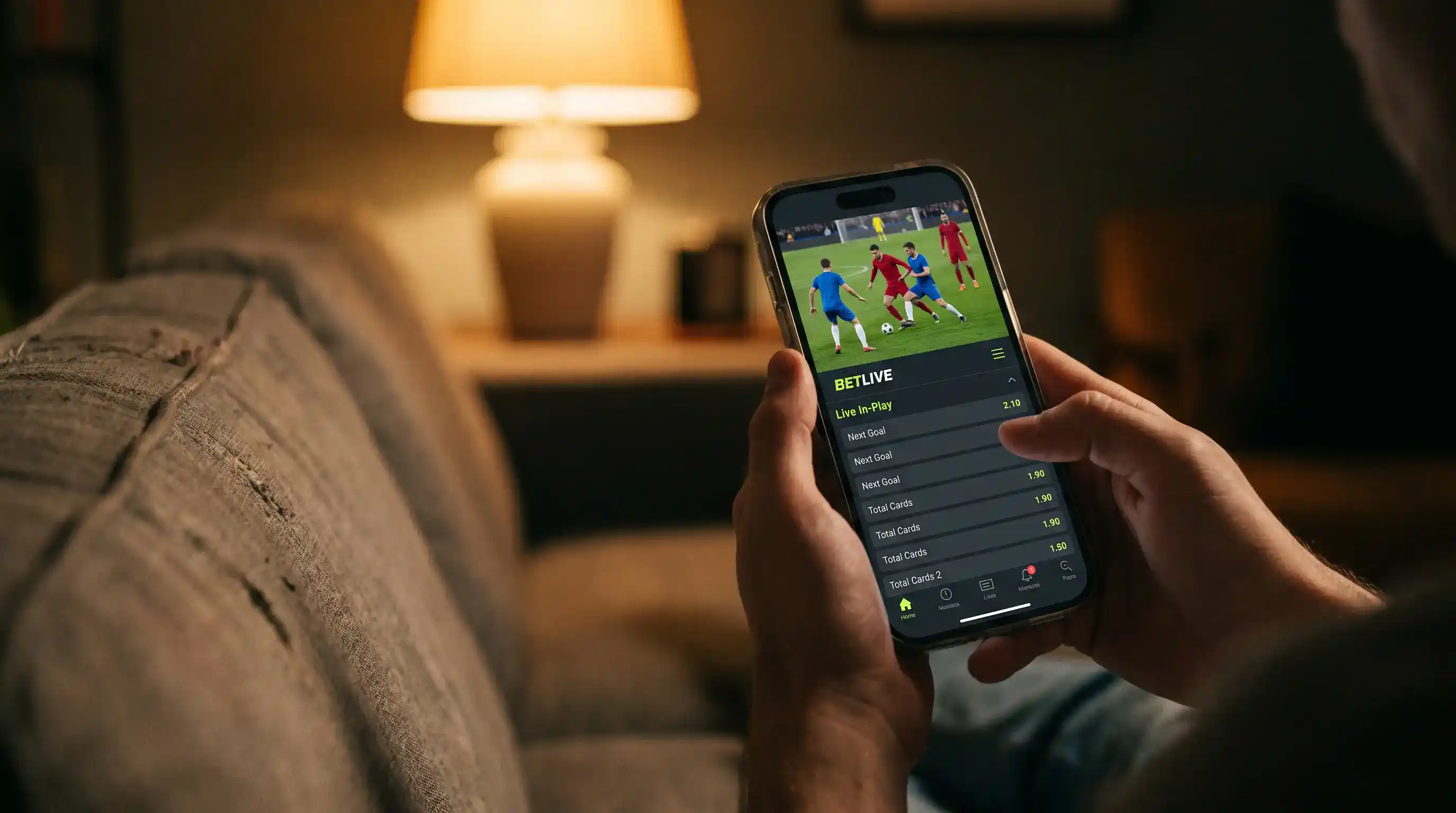
Next corner, next card and next throw-in form the microbetting layer that has expanded fastest in the UK market over the last three years. These markets are short-window and high-frequency, designed to fill the spaces between meaningful match events. They are also where in-play turnover compounds fastest, because the cycle time is short and the operator’s margin per cycle is built to be defensible.
Player-prop markets — anytime goalscorer, player to be carded, player to assist — sit on the slower-paced end of the in-play menu. They suspend around goals and substitutions and reopen with the new player odds reflecting the change. Volume here is dominated by punters extending their pre-match player picks into the live window rather than entering fresh positions in-play.
The full menu is bigger than this, and the experimental edges — winning margin live, half-time exact score live, race-to-N-goals — exist mostly for traders who want to layer specific scenarios. For ninety percent of UK punters, ninety percent of the in-play decision is made across match result, next goal, total goals and one or two player props. Treat the rest of the menu as available rather than as relevant.
When the market freezes: suspension, latency and voids
Market suspension is the single feature of in-play football betting that most often produces customer complaints, and the single feature that most often saves the customer money without their realising it. Both halves of that sentence are true. Let me explain why.
A market is suspended when the operator’s pricing engine cannot confidently update the price faster than the punter can react to an event on the pitch. Suspension is the operator’s defensive mechanism. The classic trigger is a shot on goal — the engine pauses the match-result and next-goal markets for two to five seconds while the play resolves. Less obvious triggers include corner kicks awarded, dangerous free-kicks in attacking positions, video assistant referee reviews, and any moment when the data feed itself is unstable.
From your side as a punter, the visible effect is a betting slip that suddenly says “market suspended” or grays out before you can confirm a stake. This is the moment that produces frustrated screenshots on social media. The market reopens within seconds, usually with a different price, and most punters interpret the change as the operator deliberately denying them a winning position. The truth is more boring and more universal: the suspension is automatic, applied identically across all customers on the same market, and dictated by the engine’s model of pricing risk rather than by any human decision in the moment.
Latency between the live stream and the actual event on the pitch makes suspension feel more arbitrary than it is. A typical bookmaker stream runs five to fifteen seconds behind the live event, depending on the rights chain and the geographical location of the punter. A typical broadcast stream over Sky or TNT Sports runs three to seven seconds behind. The pricing engine, by contrast, is running off a low-latency data feed that may be ahead of even the broadcast — which means the market can suspend on an event that has not yet appeared on your screen, and reopen with a moved price seconds before you see why the price moved.
Void rules complete the picture. A bet placed during an in-play market is settled according to the operator’s rules for that market, and there are scenarios in which a settled bet can be retroactively voided. The two most common are referee error (a goal is awarded and then disallowed after a VAR review) and data error (the data feed reported an event that did not in fact occur). Each major UK operator publishes its in-play void rules in the help section, and they vary in one or two places — most notably around scoreline resets after a VAR-disallowed goal. The rules are not arbitrary, but they are not identical, and a punter who runs in-play volume across more than one operator needs to read the void rules on each before relying on them.
The single piece of practical advice I can give on suspension: do not place an in-play stake at the exact moment a market reopens after a long suspension. The reopened price reflects the engine’s updated model, and the gap between the old price and the new is the operator’s signal that something material has just happened. Wait twenty seconds for the price to stabilise. If you still want the bet at the new price, take it. If the price has run away from you, accept that the suspension just saved you from a position the market itself was pricing as worse than you had judged.

Live streaming football: who carries what in 2026
Live streaming is the layer of the in-play product that turns a betting app into something a punter watches as well as uses. It is also the layer that most often interacts with the betting decision in ways the punter does not always notice — most obviously through the latency mismatch between stream and price.
The UK streaming landscape on football is a complicated piece of rights stitching. Premier League matches are not available on UK bookmaker streams — Sky, TNT Sports and Amazon Prime hold the rights chain that excludes operators. EFL matches sit differently: most Championship, League One and League Two fixtures are available on operator streams under the iFollow framework and the EFL’s broader licensing arrangement, although the specific operator-by-operator coverage shifts season to season. International club football outside the top European leagues — lower-tier Bundesliga, Eredivisie, Belgian Pro League, MLS, J-League — is broadly available on operator streams, with depth varying by operator. Domestic cup competitions and qualifiers fill the rest of the slate, with the FA Cup and EFL Cup particularly well covered in the early rounds when broadcast rights have not yet kicked in.
I have written a more detailed map of which operators carry which streams in live streaming football at UK bookmakers in 2026, including the access rules — funded account, qualifying stake, geographical restrictions — that vary across the market. The summary version: the largest UK operators carry the deepest streaming libraries, and the qualifying-stake model is more common than the funded-account model on lower-volume fixtures.
The latency question matters more than the coverage question for in-play betting. A stream that runs eight seconds behind the live event puts you, as a punter, behind the operator’s pricing engine by the same eight seconds. If you are betting in-play off the stream, you are betting on a price that may already have absorbed an event you have not yet seen. The market will frequently suspend without an obvious cause on the stream, then reopen with a moved price seconds before the cause arrives on your screen.
The cleanest workflow for in-play football, if you are using a stream, is to treat the stream as context and the price-movement pattern as the primary signal. If the next-goal market suspends and reopens with home contracted by twenty percent, something happened in the home team’s favour roughly five seconds before you see it. The price has told you that already. Wait for the stream to confirm before you take a position based on what you think happened — because if you stake before the stream confirms, you are guessing against an engine that has already seen the data.
Microbetting and the rise of in-event fast markets
Microbetting is the in-play layer that grew most aggressively in the UK market between 2023 and 2026, and it sits inside a regulatory and behavioural conversation that has been quietly tense for the last two years. The product itself is simple. The questions around it are less so.
A microbet is a bet on the next discrete event in a match — the next throw-in side, the next corner-taker, the next pass completion in a defined window. Cycle times are short, sometimes thirty seconds or less. The bet settles in the window in which it is offered, and the punter can take a new position immediately. The mechanic compresses the entire decision cycle of pre-match betting into a few seconds.
The commercial logic for the operator is the same logic that drives every other in-play product but with shorter cycles. A punter who places sixty microbets across a single ninety-minute fixture is exposed to the operator’s overround sixty times. The expected value to the operator is the cumulative margin across all those cycles, and at a typical microbetting overround of seven to ten percent, the expected loss to the punter across a sustained pattern of microbet activity is large in proportion to the cycle stakes.
What has shifted in the UK regulatory conversation is the question of whether microbetting markets create speed-of-play risk that is qualitatively different from other in-play products. The Gambling Commission has not yet introduced microbetting-specific rules, but it has flagged the category in its broader product-design work, and individual operators have begun to apply lower default deposit limits or session-time prompts on customers whose pattern of play sits heavily on the microbetting side of the menu. This is a space where regulation may yet move, and I would not be surprised to see microbetting-specific limits arrive in the second half of 2026.
For the punter, the rule on microbetting is the rule that applies to every other high-cycle product on a sportsbook: the cycle time controls the risk, not the stake size. A £1 microbet repeated sixty times across a match exposes the same total stake as a single £60 pre-match bet, but the variance pattern is completely different, and the cumulative expected loss is meaningfully higher.
Why live betting requires harder personal limits
The Gambling Survey for Great Britain estimates that 2.7 percent of British adults score eight or more on the Problem Gambling Severity Index, the clinical indicator of disordered gambling, which works out at roughly 1.4 million people. The same survey identifies live football betting as the highest-participation live format in the country. The overlap of those two populations is not trivial, and the design choices on a modern UK in-play football product interact with that overlap in ways that demand specific personal controls.
Live betting compresses the decision-to-stake cycle to a few seconds. Reflective decision-making takes longer than that. The product is therefore biased toward fast, intuition-led bet placement, which is not a moral failing on the part of the punter — it is the predictable output of a system designed to convert engagement into staked turnover. Personal risk controls are how you reintroduce reflection into a product that has, by design, removed it.
Three controls actually work in my experience. First, a daily deposit limit that is set in advance and not adjusted in-session. Every UK Gambling Commission-licensed operator must provide deposit limits as a standard feature, and the limit you choose at registration is a single decision that protects every in-play session that follows. Second, a session reminder — a configurable prompt that interrupts the session every thirty or sixty minutes and shows the cumulative stake and net position. Third, a hard rule on not increasing a stake size after a losing in-play bet within the same fixture. This is the rule that catches the chasing pattern at the moment it begins, and it is the rule most punters skip.
Victoria Corbishley, the chief executive of GamCare, made a point recently that has stayed with me: more people affected by gambling harms are choosing to start treatment, and the National Gambling Helpline is a 24/7 confidential route to support — the first conversation, she said, remains the crucial turning point. She is talking about people in active distress, not about the median punter, but the framing applies in a softer form to anyone who is using in-play football products at any scale. The first conversation with yourself — the one that sets the deposit limit before the session starts — is the most consequential conversation you have with the product.
Live football betting on a UK platform is a sophisticated, well-priced, well-regulated product. It is also a product that runs against your reflective decision-making by design. The personal controls are the bridge between those two facts, and they are not optional for anyone who plans to use the product regularly. The operator builds the engine. The punter chooses the speed limit.

Frequently asked questions
Why does my in-play football bet take 2-3 seconds to confirm?
The delay between clicking "place bet" and seeing "bet confirmed" on a UK in-play football market is the operator"s confirmation window — the period during which the pricing engine checks whether the market has moved or been suspended in the time since the price was displayed. If the price has stayed stable, the bet confirms at the displayed price. If the price has moved within the operator"s tolerance, the bet usually still confirms but at the updated price. If the market has suspended, the bet is declined and the stake returned. The two-to-three-second window is not arbitrary friction — it is the protection the operator runs against in-play arbitrage between data feeds, and it applies identically to every customer on the same market.
Will my live-streamed feed match real-time TV exactly?
No. A live-streamed feed inside a UK bookmaker app typically runs five to fifteen seconds behind the live event on the pitch, and a broadcast TV feed runs three to seven seconds behind. Both are behind the operator"s pricing engine, which runs from a low-latency event data feed and may be ahead of even the TV broadcast. The mismatch is the central asymmetry of in-play betting: the price on your screen is reacting to data the stream has not yet shown you. The practical implication is that if a market suspends without an obvious cause on the stream, something has already happened that the engine has seen, and the stream is about to catch up.
What happens if a goal is scored during market suspension?
The market suspension is the operator"s protection against pricing risk in exactly that scenario. Any bet placed before the suspension and confirmed at the pre-event price stands and settles normally. Any bet attempted during the suspension is declined and the stake returned — the bet does not enter the market at all. When the market reopens, the price reflects the goal, and any new bet from that moment forward is taken at the updated price. In short, you cannot stake into a goal scored mid-suspension, and you cannot be punished retroactively for a goal you bet around either side of the suspension.
This material was created by the Pitchledger team.
