

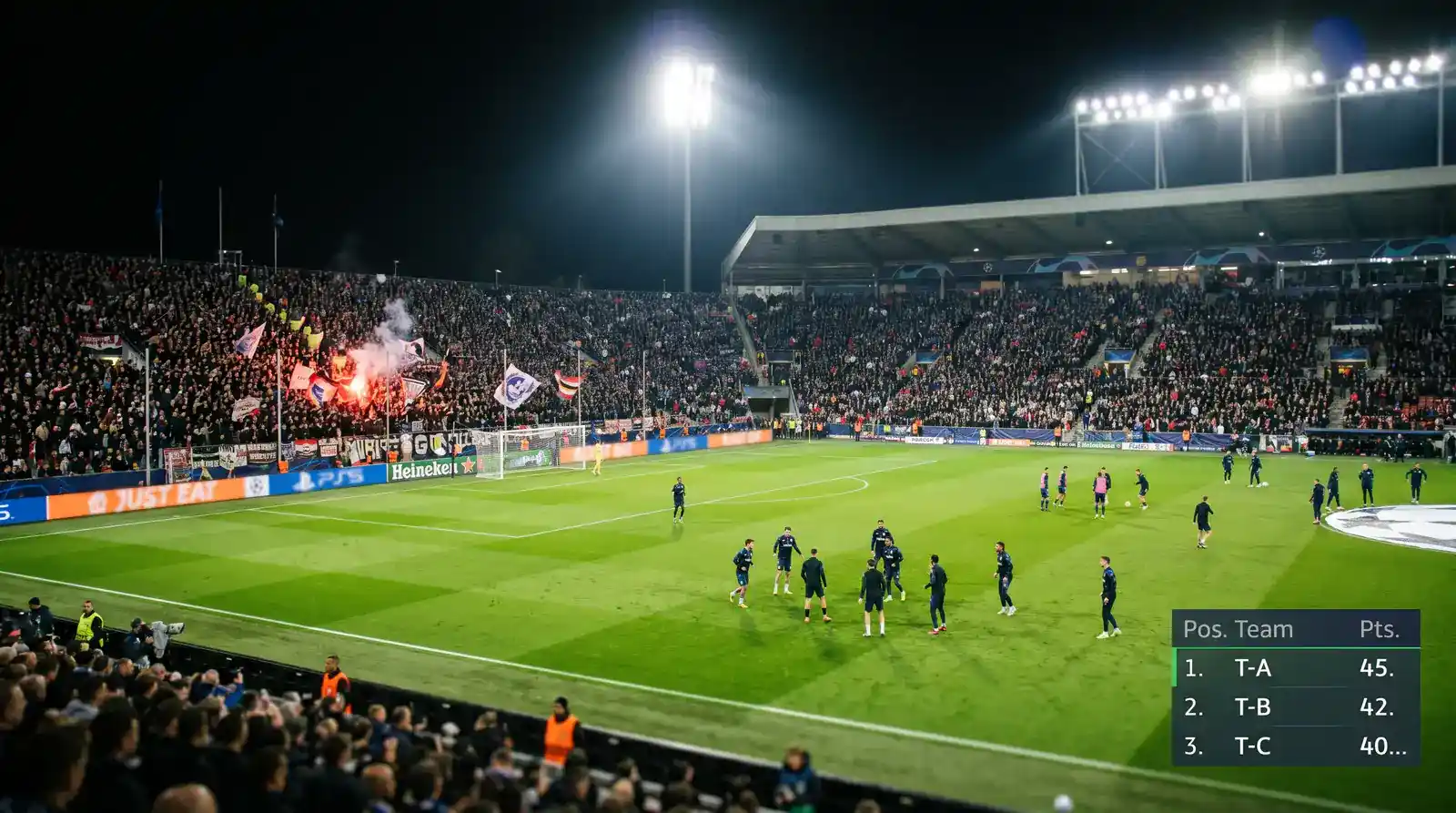
Why the Champions League sits second only to the Premier League in UK turnover
Tuesday and Wednesday nights in autumn are quiet around the rest of the British sporting calendar. The Champions League knows this and exploits it perfectly. From mid-September through to the May final, those two midweek evenings carry the second-largest football turnover at every UK operator I’ve worked alongside.

The reason is structural. UK remote sports betting generated £2.6 bn of GGY in the year to March 2025, with £1.3 bn from football alone. The Premier League takes the largest share, but the Champions League captures the next chunk because it offers exactly what UK punters reach for — recognisable clubs, prime-time scheduling, weekly fixtures across an eight-month season, and a knockout format that creates outright betting opportunities the league formats can’t match. The 2024 format change from group stage to league phase made the volume problem worse for operators (more matches) and better for punters (more market windows).
The league-phase mechanics and their effect on prices
The league phase replaced the traditional group stage in 2024. Thirty-six clubs play eight matches against eight different opponents, all in a single combined table. The top eight progress directly to the round of 16. Clubs finishing 9th to 24th enter a knockout play-off to determine the remaining eight round-of-16 spots. The bottom twelve are eliminated.

Pricing across the league phase has changed considerably from the old group-stage model. The old format had eight micro-tables of four, with the dynamics of “winning the group” and “finishing second” creating clean late-stage betting markets. The new format has one big table where the difference between 8th (auto-qualification) and 9th (knockout play-off) is enormous — and that single boundary creates the most interesting betting market the competition currently offers.
Top-eight outright markets are now a serious product across UK operators. The price moves match-by-match across the eight league-phase rounds, and the volatility is higher than the old “qualify from group” market because the boundary is sharper. Clubs sitting 10th with two matches to play face genuinely different scenarios depending on remaining opponents — and the prices move accordingly.
Outright winner versus top-eight finish markets
The outright winner market is the marquee Champions League product but it’s not the one that pays best from a punter’s perspective. Outrights on competition winners get bet heavily by recreational money throughout the season, which keeps the books wide and the favourites short. Real Madrid, Manchester City, Bayern Munich and PSG carry permanent overround weight regardless of form.
Top-eight finish markets are mathematically more interesting. The probability distribution is binary per club — make it or don’t — and the operator’s overround is spread across 36 clubs instead of concentrated on the winner. Margins on top-eight markets at top UK operators sit around 105–107%, which is wide but workable.

The other market I’d flag is the elimination-stage outright — winner from this point in the knockout — which opens once the round of 16 is set. The market is far smaller in turnover than the season-long outright, so operators carry tighter books on it. Prices move quickly between rounds as the bracket clarifies, and there are genuine value windows in the 48 hours after a round completes and before the next round prices firm up.
Knockout pricing cycles — first-leg, second-leg, dead-rubber
The knockout rounds in the Champions League follow a clear pricing rhythm and recognising it gives you genuine timing advantage.
First-leg prices open a few days before the match and stay relatively wide. The two-legged structure means the operator’s risk is spread across both matches, so they don’t tighten books aggressively until the second leg approaches. Sharp value in first-leg matches typically lives in the underdog away leg, where the operator overprices the home favourite’s win probability against the data.

Second-leg pricing is where the books get sharp. The aggregate score from the first leg combined with home advantage creates a clear pre-match scenario, and the trading floors price aggressively. The dead-rubber problem — second legs where one side has effectively won the tie in the first match — is the operator’s nightmare. Books on dead-rubber second legs run wider than economic logic suggests because the team that’s already through can rest players, rotate, and produce wildly variable performance.
The handful of dead-rubber second legs each round are the ones I’d avoid backing in any direction. Operators know they can’t price them well and the overround compensates accordingly. Either fade the dead-rubber entirely or look at Under-goal markets, which tend to be the more reliable expression of a dead-rubber match.
British clubs in the UCL — sentiment and price drift
British punters bet British clubs, and that’s the single most predictable behavioural pattern in UK Champions League betting. Manchester City, Liverpool, Arsenal, Chelsea, Aston Villa or whoever else qualifies in a given season — UK money piles on at every stage, regardless of opponent or form.
That patriot-flow effect distorts prices in two predictable ways. Outright prices on British clubs run consistently shorter at UK-facing operators than at international operators serving non-UK markets. The gap is rarely large — typically 5–15% — but it’s persistent. The other distortion is in handicap markets, where British favourites are priced shorter on handicap lines than the underlying probability suggests.
The price-shopping opportunity isn’t between UK operators (who all carry the same patriot flow) but between UK operators and international or exchange-linked products. A British favourite at 6/4 at a mainstream UK operator might trade at 13/8 on an international book. The arbitrage isn’t always actionable depending on your account holdings, but the spread is real.
William Hill held 37.83% of UK sports betting PPC click-through in February 2026, which gives you a sense of how concentrated the retail flow is at the largest UK operators. The largest books are also the ones with the strongest patriot-flow exposure, and the patriot drift is most visible at the marquee end of the operator spectrum.
Bookmaker coverage and live-streaming notes
Champions League streaming through UK bookmakers is the most restricted part of the product. UEFA’s broadcasting rights with TNT Sports lock most matches behind broadcast or subscription paywalls, and UK bookmakers don’t carry live video of UCL matches in any meaningful form. What you’ll see on the operator’s match centre is real-time stats, xG tracking, momentum graphs and play-by-play feeds, but not the actual broadcast video.

This is a meaningful gap relative to EFL streaming, where bookmaker coverage is broad and reliable. The implication for the UCL-focused punter is that you need a separate broadcast subscription to watch the matches, with the bookmaker’s role limited to market-making and stats display.
Coverage of the betting markets themselves is broad across UK operators. Every UKGC-licensed bookmaker carries deep UCL coverage — outrights, league-phase finish positions, knockout-round outrights, individual match 1X2, Asian handicap, goals markets, Bet Builder, player props. The depth is genuine because UCL turnover justifies the trader’s time in a way that smaller continental competitions don’t.
For the parallel structure of how UK operators price the Europa League and the newer Conference League — both of which sit alongside the Champions League on the European calendar — my breakdown of Europa and Conference League betting markets covers the rotation-risk and Thursday-night pricing dynamics that affect those competitions specifically.
The second-string European product that pays the bills
The Champions League sits in the UK football betting calendar as the marquee midweek product, and the operator strategy reflects it. Prices on flagship UCL fixtures run close to Premier League tightness on 1X2 markets, the in-play products are well-supported, and the outright menus run year-round across multiple parallel markets.
What the product doesn’t offer is the volume opportunity of the Premier League — fewer matches, smaller player pool, more concentration of turnover on a handful of marquee clubs. The compensating advantage for the punter is that the markets are sharp and the prices honest, with the only real soft spot being the patriot-flow distortion on British clubs and the dead-rubber second-leg problem in the knockout stages. Avoid those two structural traps and the UCL is one of the more honestly-priced football products in the UK calendar.
Why does the UCL outright shorten so sharply once teams qualify for the round of 16?
The probability shift is genuine — auto-qualifiers and play-off winners look quite different probabilistically when you remove half the league-phase field. But the price compression is also sharper than the probability suggests because retail money concentrates onto the remaining clubs. The drift opens a small window of fading-the-favourite value in the 48 hours after each round.
Are there Best Odds Guaranteed offers on UCL outrights?
At most major UK operators, yes — BOG on UCL outright winner and certain ante-post markets is standard. The catch is that the qualifying cut-off price reference can be tricky to identify in advance, and the BOG mechanic only applies to cash-funded stakes. Free-bet stakes typically don"t qualify.
Do UK bookmakers stream UCL matches directly?
No. Champions League broadcast rights are held by TNT Sports and aren"t sub-licensed to UK bookmakers for live video. What you"ll see on operator platforms is real-time stat tracking, xG visualisation and play-by-play feeds, but not the broadcast video itself.
This material was created by the Pitchledger team.
