


The 25-leg Bet Builder I built once just to see what would happen
Mid-season, a couple of years ago, an idle afternoon. I opened a Premier League fixture in a UK app and started loading legs into the Bet Builder. Result, BTTS, total goals, corners, cards, individual player shots, individual player goals. Twenty-five legs in, the price was something like 8000/1. The implied probability across all 25 legs being correlated through one match: 0.012%. Did I bet it? No. But the exercise taught me more about how Bet Builders are priced than any product write-up ever did.
Bet Builders are the fastest-growing product in UK football betting because they let punters express specific match views with surgical detail. They’re also the highest-margin product in UK football betting, because the correlation pricing inside them gives operators a structural edge that doesn’t exist in independent multi-bets. Understanding what’s happening under the hood is the difference between fun-flutter Bet Builders and Bet Builders that hold positive expected value.
How correlation pricing actually works
An independent multi-bet — three different fixtures, three selections — multiplies the prices directly. A 2.00 leg combined with a 2.00 leg combined with a 1.50 leg gives 6.00 displayed. That’s the mathematics of independent events.
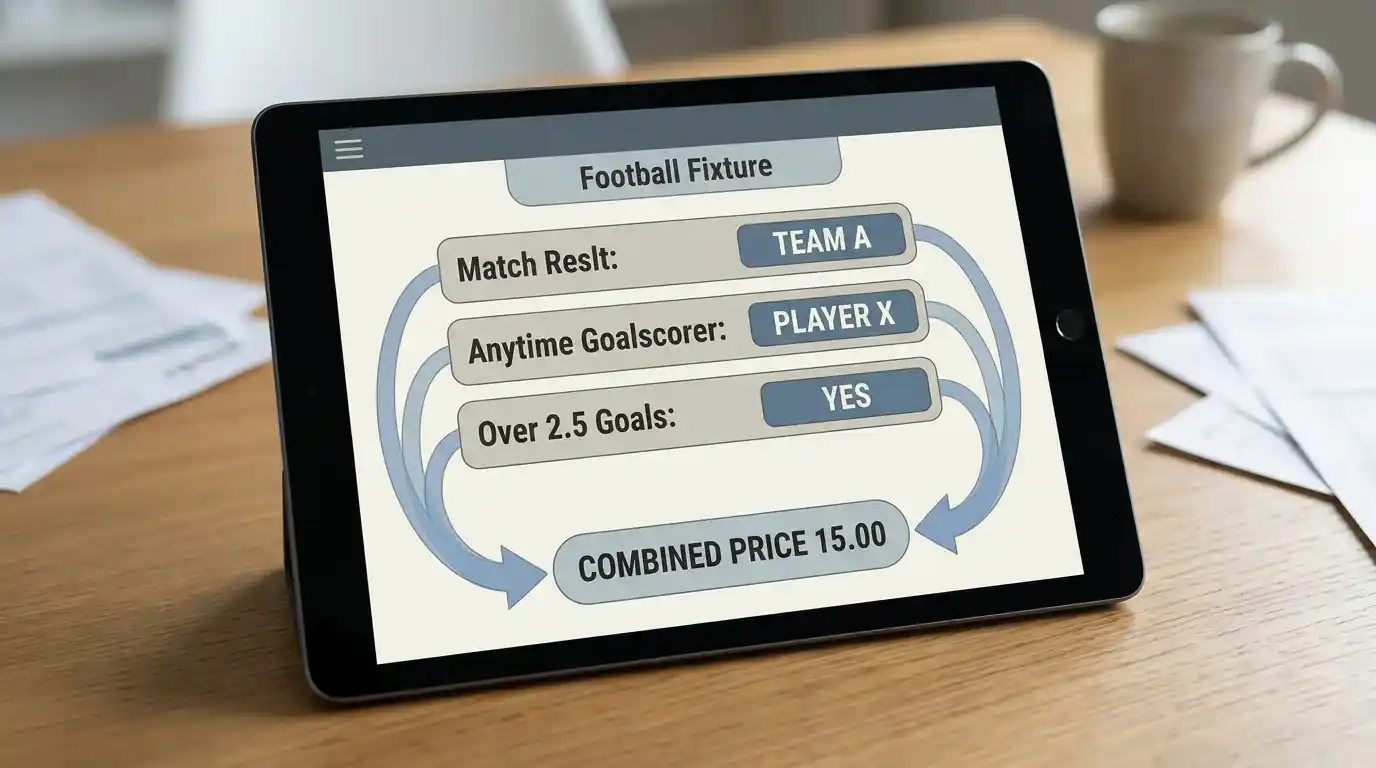
Same-game legs aren’t independent. If your Bet Builder includes “favourite to win” at 2.00 and “favourite striker to score” at 2.50, those legs are correlated — the favourite is more likely to score if they win, and they’re more likely to win if their striker scores. The independent multiplication would give 5.00. The bookmaker’s correlation engine reduces that price because the joint probability is higher than the product of the marginals.
What the operator displays is usually somewhere between the independent product (5.00) and the true joint probability (maybe 4.00). The displayed price might be 4.40. That gap between displayed and true is the structural operator edge in same-game multis — and it scales rapidly as you add more correlated legs.
Where correlation discounts are conservative
Operators don’t always discount correlation aggressively enough. The pricing engines have to be calibrated, and the calibration is conservative — operators would rather under-discount than over-discount, because over-discount means displaying a price shorter than punters expect and losing volume.

That conservatism creates the occasional value pocket. “Both teams to score and over 2.5 goals” is the classic example — these two outcomes are correlated about 85% in the Premier League. The independent multiplication of BTTS yes at evens and over 2.5 at 5/6 gives 11/6. The displayed combination price is typically around 7/4 or 13/8 — a 5-10% discount. The true joint probability suggests the displayed price should be closer to 6/5 or 5/4 to fully capture the correlation.
The combination is positive expected value at 7/4 if the actual joint probability is 50%. That’s a structurally good bet when the underlying fixture profile supports it. The number of fixtures that fit the profile in a Premier League season is small but not zero — perhaps 8-12 fixtures per season where the BTTS+Over 2.5 combination at 7/4 holds genuine value.
Where correlation discounts go too far
The opposite happens too. Some combinations get over-discounted because the operator’s model is conservative on negative correlations. “Favourite to win to nil” combined with “under 2.5 goals” — these are heavily positively correlated, but the operator’s correlation engine sometimes treats them as independent or near-independent because the model isn’t tuned for this specific joint.

Independent multiplication of “favourite to win to nil” at 11/4 and “under 2.5 goals” at 6/5 gives 6.05. The displayed combination is sometimes 5.50 — a discount of around 9%. But the actual joint probability is much higher than independent — perhaps 28-30% — implying a fair price closer to 7/2 or 4/1. The displayed 11/2 is too long.
Spotting these mis-priced combinations requires running the maths fixture by fixture. It’s tedious work. But the punters who do it produce small, consistent edges across the season that compound — much more reliably than chasing big-multi long shots.
The volume profile that makes Bet Builders dangerous
Bet Builders are positioned by UK operators as the headline product. App home screens lead with “Build a Bet” tools. Marketing emails push pre-built Bet Builders. Live in-play prompts encourage building bets with three, four, five legs.

That positioning is commercial because the maths is good for the operator. A typical four-leg Bet Builder runs at a 12-15% margin on the actual joint probability, against 4-6% margin on a single match outcome. The operator earns three times more per pound staked on Bet Builders than on outright match bets. UK gambling reported £1.3bn in football GGY last year, and a growing share of that comes from Bet Builders specifically.
The volume profile also means responsible-play infrastructure focuses heavily on Bet Builders. More people affected by gambling harms now access treatment than before — Victoria Corbishley of GamCare has noted that this rising treatment engagement is a positive sign that recognition and help-seeking are improving. The operator deposit limits, session reminders, and reality-check prompts that the regulator has tightened around major fixtures are specifically calibrated to interrupt the kind of high-frequency, in-play Bet Builder activity that produces sustained losses.
Practical Bet Builder construction
The Bet Builders I actually bet are usually three legs, all with clear positive correlation, on a fixture where I have a specific tactical read. Three legs because that’s the maximum at which I can still mentally model the joint probability without resorting to a spreadsheet. Clear positive correlation because that’s where the operator’s correlation engine is most likely to leave value on the table.

A typical construction: “Favourite to win”, “favourite striker to score anytime”, “over 2.5 goals”. All three legs correlate positively. Independent multiplication of three prices like 4/6, 4/5, 5/6 gives roughly 5/2. The combination usually displays at 7/4 or 15/8 — a discount of around 25-30%. The true joint probability is usually around 30-35%, implying a fair price of 7/4. The combination is roughly fair, occasionally slight value.
What I avoid: combinations of negatively-correlated legs that the operator hasn’t priced correctly. “Favourite to win and under 1.5 goals” — these are slightly negatively correlated (favourites scoring goals to win), but the operator’s correlation engine sometimes treats them as positively correlated by default. The displayed price is too short relative to the actual joint probability. The trap is that the displayed price looks reasonable but isn’t, and the punter who hasn’t done the maths is unlikely to spot it.
The in-play Bet Builder
In-play Bet Builders compound the pricing complexity. The base prices update second by second. The correlation engine has to re-tune as game state changes. The combinations the operator offers in-play are filtered to ones the model can price confidently — which means the most interesting combinations (rare cross-market plays) often aren’t available in-play because the operator can’t model them in real time.

What’s available in-play is usually the standard menu: result, BTTS, over/under, anytime scorer, corners. Pricing on these in-play combinations is generally efficient — close to independent multiplication minus a small discount — because the in-play model has less time to refine correlation estimates. The structural edge for the punter in-play comes from spotting moments where game state has shifted in a way the model hasn’t caught yet, not from the pricing engine’s correlation calibration.
That’s a different skill from pre-match Bet Builder analysis. In-play tactics for UK football reward speed, attention, and pattern recognition. Pre-match Bet Builders reward mathematics, patience, and willingness to run the numbers.
What Bet Builders teach about football and pricing
The Bet Builder is the most demanding football betting product because it forces you to think about correlation. Two events that look independent — a result and a goal total — are correlated. Two events that look heavily correlated — a result and a scorer — are sometimes less correlated than you think.
Punters who develop fluency with correlation tend to bet better across all football markets, not just Bet Builders. They stop double-counting positive evidence (“favourite is in great form” and “favourite striker is in great form” aren’t two independent reasons to bet the favourite). They start spotting which markets carry redundant information and which markets carry genuinely new information.
That mental model is the dividend from spending time on Bet Builder mathematics, even if you never bet a five-leg Bet Builder for real. The discipline carries forward into every other market the season offers. Treat the Bet Builder as a learning environment and the small wins from selectively betting the correlated-and-mis-priced combinations are bonus.
Because the maths is good for the operator and the product feels good for the customer. A four-leg Bet Builder typically runs at 12-15% margin against 4-6% on a single outright. The customer gets a satisfying long price on a specific match view. The operator earns three times more per pound staked. Commercial alignment doesn"t get any clearer than that. When the legs are heavily positively correlated and the operator"s correlation engine is conservative — typically BTTS combined with over 2.5 goals on Premier League fixtures, or "favourite to win and striker to score" on heavily-favoured matches. Run the actual joint probability against the displayed combination price. If displayed is longer than fair joint, there"s value. Almost never. Operator-created pre-built Bet Builders are tuned for retail appeal — long prices, exciting combinations, broad market appeal — not for value. The correlation discount is usually aggressive in the operator"s favour. The exceptions are pre-built Bet Builders that mirror obvious value combinations like "BTTS plus over 2.5", and even those benefit from being constructed yourself with leg-by-leg control.Why do operators encourage Bet Builders if they"re heavier margin?
When are same-game multis genuinely value plays?
Are pre-built Bet Builders worth betting?
This material was created by the Pitchledger team.
