


The free bet that taught me how operators really pay out promotions
I took a “bet £10 get £30 in free bets” sign-up offer at a major UK operator in 2018. Did the qualifying bet, lost it as expected, claimed the £30 in free bets. Then read the terms properly. Free bets returned winnings only, not the stake. A £30 free bet at 2.00 paid out £30, not £60. The actual cash value was nowhere near the headline number.
That’s how every UK free bet works in 2026 and that’s how every UK free bet has worked since the regulator standardised promotional terms. Operators advertise generously but settle precisely. The headline £30 free bet is worth somewhere between £15 and £25 in real money depending on what you bet it on. Understanding that gap is the first step in evaluating any UK football promotion realistically.
The qualifying bet and its true cost
Most UK football promotions require a qualifying bet — typically £10 or £20 at minimum odds of 4/5 or evens — before the free bet credit is released. The qualifying bet has to lose, in many promotional structures, before the free bet activates. Operators frame this as “risk-free” or “money back as free bets if your first bet loses”.

Mathematically, the qualifying bet’s expected cost is the bookmaker’s overround share. A £10 bet at 4/5 (decimal 1.80) against a 105% market has expected loss of about £0.28 per bet. Over many bets, that’s the operator margin extracted. For a single bet, it’s a probabilistic loss between £0 and £10. The “risk-free” framing is misleading — the bet has real expected cost, just smaller than the face value.
The free bet credit released on a losing qualifier is worth real money but less than face value. Stake-not-returned (SNR) free bets at 2.00 odds pay 50% of the headline value as cash. At 3.00, they pay 67%. At 1.50, they pay 33%. The promotional sweet spot for cashing out free bets is even-money to 2.50 selections, where the SNR conversion rate is highest relative to typical betting patterns.
Price boosts and the asymmetric value
Price boosts are the most consistently valuable promotional form in UK football betting. The operator picks a market — usually a popular outcome like a favourite striker scoring, a top-six team winning, or a specific scoreline — and offers an enhanced price on it for a limited time.

A boosted price of 5/2 on a market that’s standardly priced at 7/4 represents an implied probability shift from 36.4% to 28.6%. If you believe the actual probability sits at 35%, that boosted price has 22.5% positive expected value. Genuinely substantial value for a small wager.
The catch is that price boosts come with limits. Maximum stake might be £10 or £25. The operator caps the actual money flowing into the boosted line. That’s commercial — operators boost selections expected to generate engagement and traffic, not selections they’d lose unlimited money on. The cap makes the boost a small-scale tactical wager, not a position you can size into.
Across a Premier League season, taking every well-priced boost at a small stake produces a positive expected value stream that compounds. The boosts that genuinely work for the punter are usually the early-week openers, where the operator hasn’t yet seen retail flow concentrate on the boosted line and the price hasn’t fully adjusted to market consensus.
Acca insurance and its actual mathematical value
Acca insurance — refunding your stake if one leg of a multi-leg accumulator loses — is one of the most heavily-marketed UK football promotions. The mechanics of acca insurance work in the punter’s favour for specific multi sizes, but the value is smaller than the headline implies.
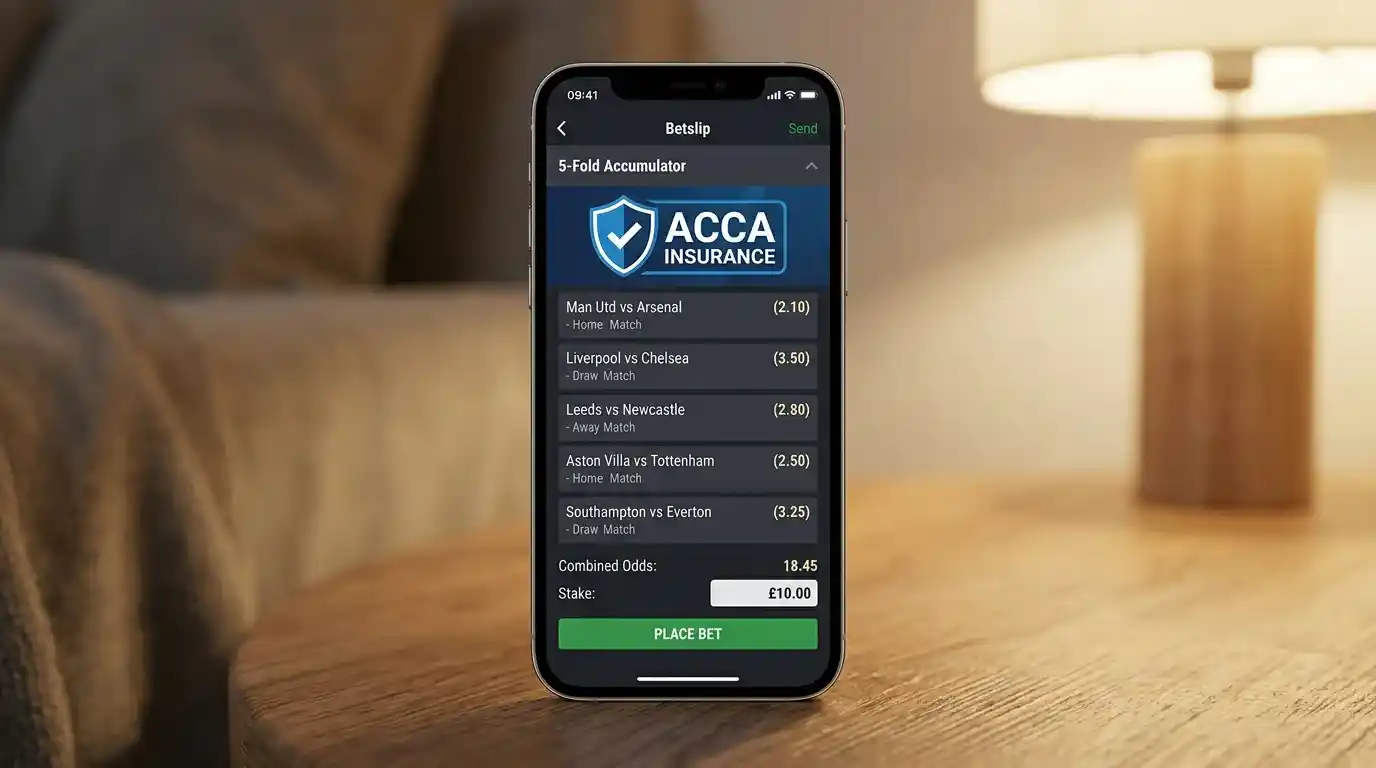
A five-fold acca with each leg priced 4/5 has a successful probability of about 18.5%. The expected return on £10 stake is £10 × 0.185 × 6.83 (combined decimal price) = £12.63, or +£2.63 per bet. Add acca insurance on “one leg loses” and the expected return improves by the probability of “exactly one leg loses” times £10 refund = 0.396 × 10 = £3.96. Total expected return becomes +£6.59. That’s a meaningful improvement in a structurally negative-expectation product.
The promotion turns a 26% positive ROI bet into a 66% positive ROI bet — but the underlying acca is still a low-probability bet with high variance. You’ll lose most weeks. The insurance softens the loss frequency but doesn’t change the long-run maths much because the operator builds the insurance cost into the underlying price overround.
Bet boosts and the bonus-on-multi tilt
Bet boosts (sometimes “acca boosts” or “multi boosts”) add a percentage to your acca returns based on the number of legs. A 4-leg acca might get 5% added. A 10-leg acca might get 50% added. Some operators run “20% extra on any 5+ leg acca” as standing promotions.
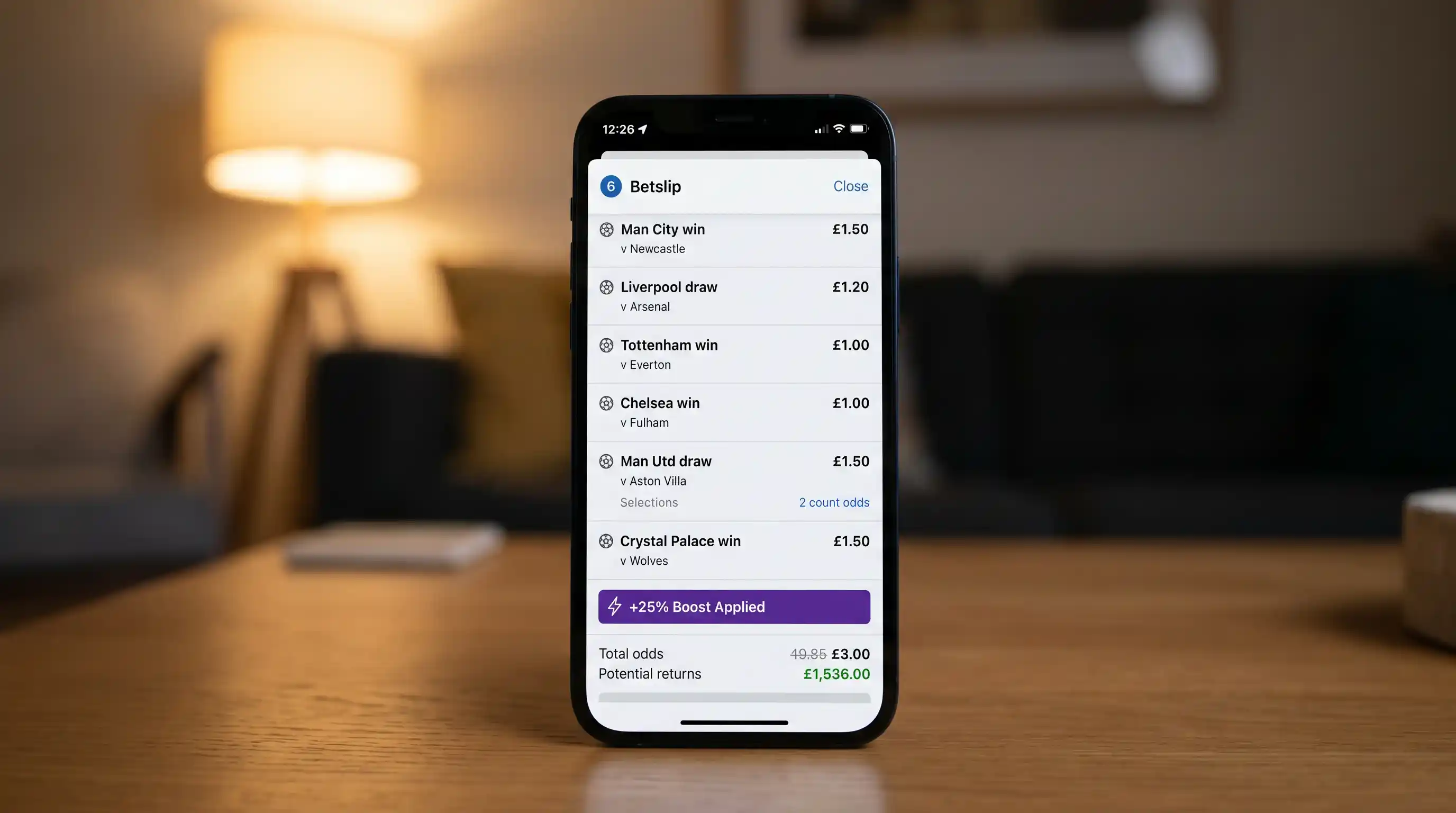
The boost converts to expected value depending on the acca’s underlying expected return. A 5-leg acca at 5/1 combined decimal (6.0) with a 25% boost effectively prices at 6.75. If the original acca had -5% expected return, the boost lifts it to roughly +15%. Genuinely shifts the maths.
But the structural issue with acca boosts is that they encourage longer accas, which carry higher variance and higher overround. The operator’s promotional design pushes punters towards bets the punter would otherwise sensibly avoid. A 10-leg acca with a 50% boost might be positive expected value, but it’ll hit roughly once in 250 attempts, with most of those attempts producing total losses. The variance profile is unsuitable for most retail punters even when the expected value is positive.
Best Odds Guaranteed and the daily promotional currency
Best Odds Guaranteed (BOG) is technically a promotion at most UK operators but functions more like a standing market feature. The BOG mechanic on football means if the price you took drifts to a longer SP-equivalent at kickoff, you’re paid at the longer price.

BOG is the most consistent positive expected value promotion in UK football betting because it’s not capped at small stakes and it pays out across the season on every ante-post football bet you place. A typical punter who price-shops carefully and bets in the morning before the match might see BOG apply on 15-20% of their winning bets, adding 5-10% to the realised winnings on those bets.
That’s worth £30-50 over a season of regular Saturday football betting at modest stakes. Not life-changing, but meaningful as a steady promotional drip. The operators offering BOG on a broad sports menu are the operators worth opening accounts with for football-specific betting volume.
The free-bet stacking trap
The classic mistake with UK football promotions is treating free bets as additional bankroll. Punter wins on a £10 stake, has £40 in profit, claims a £20 free bet, bets it on a long shot, loses it, and feels no loss because “it was free anyway”.

It wasn’t free. The £20 free bet had cash equivalent value of £8-15 depending on the punter’s selection patterns. Losing it is a real opportunity cost. Treating it casually means systematically extracting less value from promotional credit than is available.
The disciplined approach is to bet free bets exactly the way you’d bet cash — value-based selection, controlled stake sizing relative to expected outcome, no chasing long-shot rewards just because the credit “feels free”. UK gambling reported 24.4M active accounts across the licensed market last year, and the typical retail account leaves a meaningful share of its promotional credit unrealised because of exactly this casual treatment. Operators benefit from that pattern. The disciplined punter doesn’t.
Regulatory restrictions and where promotions can’t go
UK promotional structures have tightened over the last five years. The 2026/27 Premier League season brings front-of-shirt sponsorship restrictions, and adjacent regulatory pressure has pushed operators away from aggressive welcome offers, in-play prompts targeted at first-time depositors, and “free bet” credit on losing first wagers structured in ways that obscured the underlying terms.
What’s left is a more conservative promotional environment than the early 2020s offered. The headline numbers are smaller but the terms are clearer. A £30 free bet on a £10 qualifier in 2026 actually means £30 in stake-not-returned credit on selections at minimum 4/5 odds with explicit cash conversion limits. The “marketing copy promises £100 free, delivers £15 cash” gap that existed in earlier years has narrowed significantly.
For the punter, the regulatory tightening is broadly positive. The promotions that exist are more honestly priced. The promotions that look genuinely valuable usually are genuinely valuable, after reading the terms. The shape of the UK promotional market in 2026 rewards punters who understand the maths behind the offers, and punishes punters who chase headline numbers without checking what they’re actually committing to.
Because UK free bets pay "stake not returned" (SNR) — the winnings only, not your stake back. A £30 free bet at 2.00 pays £30, not £60. The cash equivalent depends on the odds you bet it at, typically 50-67% of face value at common football prices. Treating the face value as cash equivalent systematically overstates promotional bankroll. Often yes, but capped at small stakes. A boosted price of 5/2 against a market price of 7/4 is genuine positive expected value if the underlying probability sits near the market price. Operators cap boost stakes at £10-25 to limit downside. Across a season, betting every well-priced boost at small stakes produces a positive expected value stream. Yes, if you"ll actually use each account afterward. The welcome offers are designed to acquire customers, and a punter who claims the bonus and never returns is exactly what operators expect. The compliance burden — verification, deposit limits, identity checks — is real, so multi-account welcome bonus farming has practical limits. Two or three accounts at major operators is the practical sweet spot.Why are free bets worth less than their face value?
Are price boosts genuinely value plays?
Should I take welcome offers from multiple operators?
This material was created by the Pitchledger team.
