


The Bet Builder reshaped how Britain bets on football
When I first started pricing same-game multi products on a UK book in 2017, the calculation was done by hand for the half-dozen punters who phoned the trading desk asking for a custom multi. Every leg had to be assessed individually, every correlation had to be argued through, every price had to be defended in front of a head of trading who had been trained on the same maths I had. Eight years later, the Bet Builder is a tap-and-confirm feature on every UK app, and the same calculation runs in milliseconds against millions of customer-driven combinations.
The transformation is the single biggest product shift the British football betting market has seen since the rise of in-play. Before the Bet Builder, the only way for a UK punter to combine selections from a single fixture was the long-standing scorecast and wincast markets, both of which were narrow and human-priced. The Bet Builder gave the customer a sandbox: pick any combination of compatible markets from a single match, get a single price, place a single stake, settle once. The mechanic looked like an accumulator. It is not an accumulator. The maths is fundamentally different, and most punters using the product do not know in which direction the difference cuts.
The Gambling Commission’s industry statistics for April 2024 to March 2025 show £1.3 billion of remote football betting gross gambling yield in Great Britain. A meaningful share of that yield now flows through Bet Builder products — exact splits are not published, but the trading-desk view across the leading operators is that same-game multis account for somewhere between fifteen and thirty percent of football turnover at the largest UK books, with growth still trending upward through 2025 and into 2026.
This article explains what a Bet Builder actually is, how the price you see is constructed, why the price is almost always shorter than the naive multiplication of the legs, and how the operator’s choice of pricing engine creates real differences between the same combination at different UK sites. By the end you should be able to look at any Bet Builder slip and tell whether the price reflects the correlation honestly or whether the operator is taking an extra cut on the assembled product.
From accumulator to same-game multi
The cleanest way to understand a Bet Builder is to start with the thing it is not. An accumulator is a multi-leg bet where every leg comes from a different event, and the legs are statistically independent — the result of one match does not influence the result of another. The price of an accumulator is the simple product of the legs, less the operator’s margin, because independence makes the maths trivial. Manchester City winning their fixture does not change the probability of Arsenal winning theirs.
A same-game multi is a multi-leg bet where every leg comes from the same event, and the legs are almost never independent. The result of one leg directly influences the probability of another. Manchester City winning their fixture changes the probability of both teams scoring in that same fixture. The probability of over 2.5 goals interacts with the probability of any individual player scoring. The probability of a red card interacts with the probability of over 9.5 cards. Every leg pair has a correlation coefficient, and the joint probability of the combined slip is not the product of the marginal probabilities.
The accumulator price arithmetic is: take the decimal odds of every leg, multiply them, then apply a small adjustment for the operator’s compounded margin. The Bet Builder price arithmetic is: build a joint probability distribution across all selected outcomes given the operator’s match model, calculate the probability of all legs winning simultaneously, convert to a decimal price, then apply the operator’s margin. The two processes look superficially similar from the outside. The outputs can differ by twenty or thirty percent on the same notional set of legs.
I cover the traditional accumulator side of the trade-off — when a treble across three matches makes more sense than a same-game multi on one — in football accumulator strategy, and the contrast between the two products is the cleanest way to understand what a Bet Builder is actually doing. The Bet Builder collapses the multi-event variance of an accumulator into a single fixture, in exchange for handing the operator a margin on a correlation calculation that the punter cannot independently verify. That trade-off is the whole product.
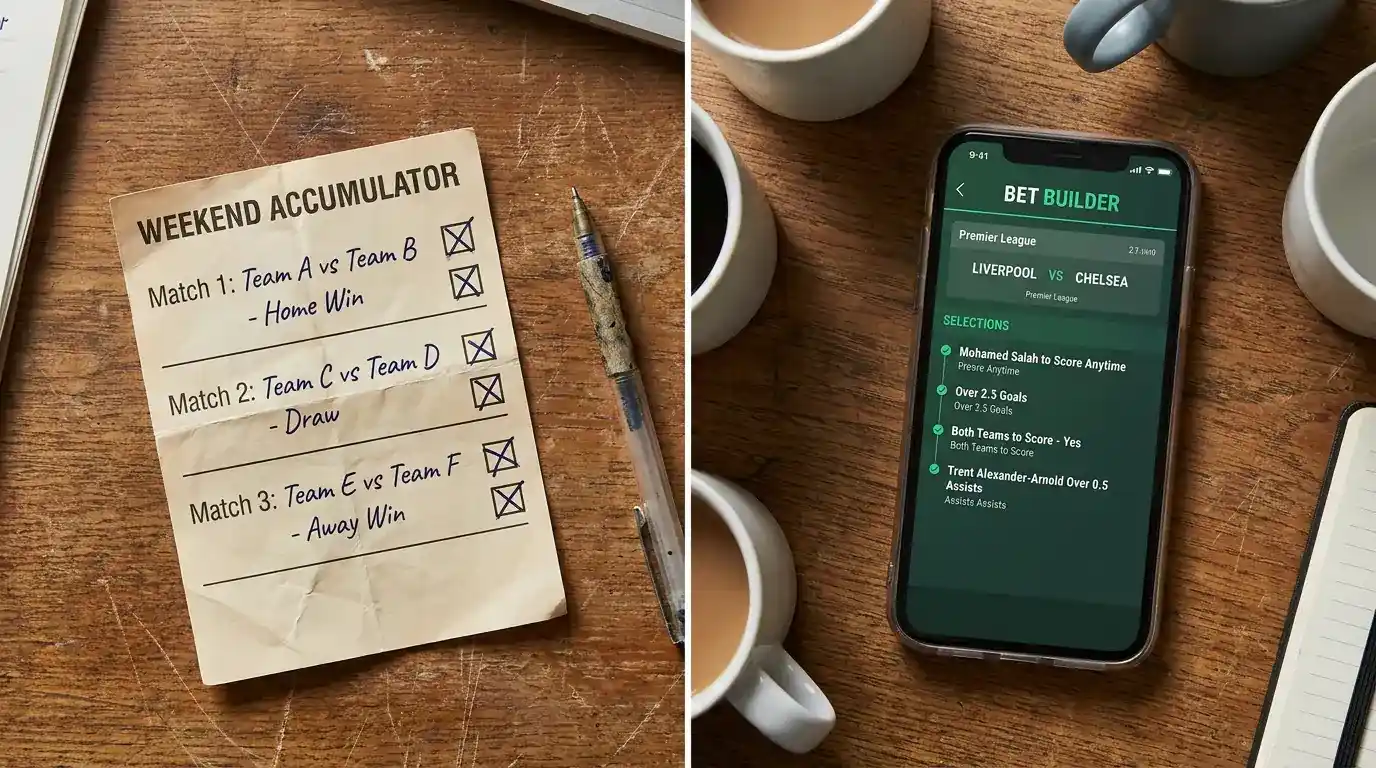
Correlated legs: why 1.5 × 1.6 ≠ 2.4
Here is the maths that every Bet Builder punter should see at least once. Take two markets on a single Premier League fixture: home team to win, priced at 1.50 in decimal, and over 1.5 goals, priced at 1.60. Naive multiplication gives 1.50 × 1.60 = 2.40. The Bet Builder price you actually see for the same combination is almost always lower — often 2.10 or 2.15 once the operator’s margin is included. The difference is the correlation.
The two legs are positively correlated. When the home team wins, the match has produced at least one goal, which is the home team’s. The probability of the over-1.5 leg conditional on the home team winning is substantially higher than the unconditional probability of over 1.5 goals across all match outcomes. Put differently, the two events are not independent: if you know one happened, you have new information about the other. The joint probability of both is therefore higher than the product of the marginal probabilities, which means the fair price of the combination is shorter than the product of the individual prices.
The general principle is straightforward: when legs are positively correlated, the fair joint price is shorter than the product. When legs are negatively correlated, the fair joint price is longer than the product. The Bet Builder engine knows this — the model has to know this, or the operator would be giving away expected value on every combination — and the price you see is the engine’s best estimate of the joint probability, plus the operator’s margin.
The legs in football where correlation is positive and large include: home team to win combined with any home-team player to score; both teams to score combined with over 2.5 goals; any team to score in both halves combined with over 1.5 goals; first half over 0.5 goals combined with full-time over 1.5 goals. Each of these pairs has a correlation coefficient meaningfully above zero, and the Bet Builder engine prices them accordingly.
The legs where correlation is negative and large include: home team to win combined with under 1.5 goals (a low-scoring win is rarer than a high-scoring win in the Premier League); both teams to score combined with under 2.5 goals (the joint probability is non-zero but constrained); any draw combined with one team to win to nil. Each of these pairs produces a fair joint price longer than the simple product, and a well-priced Bet Builder engine should reflect that — though in practice many UK engines are calibrated more carefully on positive correlations than on negative ones, which is where some of the variation between operators originates.
The cleanest piece of advice I can give a punter constructing a Bet Builder is to expect the price to be lower than your naive multiplication for any combination of legs that “go together” in football logic. If your slip prices longer than the naive product, the operator is either giving you a price that reflects a negative correlation you have inadvertently constructed, or — much less likely — the engine has mispriced the joint distribution. The first explanation is correct in roughly ninety-five percent of cases.

Combinations punters reach for and the price tag attached
The popularity of Bet Builder combinations follows a distribution that traders learn to recognise in their first six months on a UK football desk. The same handful of patterns dominate the slips placed every weekend, and the operator’s pricing engine is heavily tuned against exactly those patterns. Knowing the popular combinations tells you where the operator’s edge is sharpest.
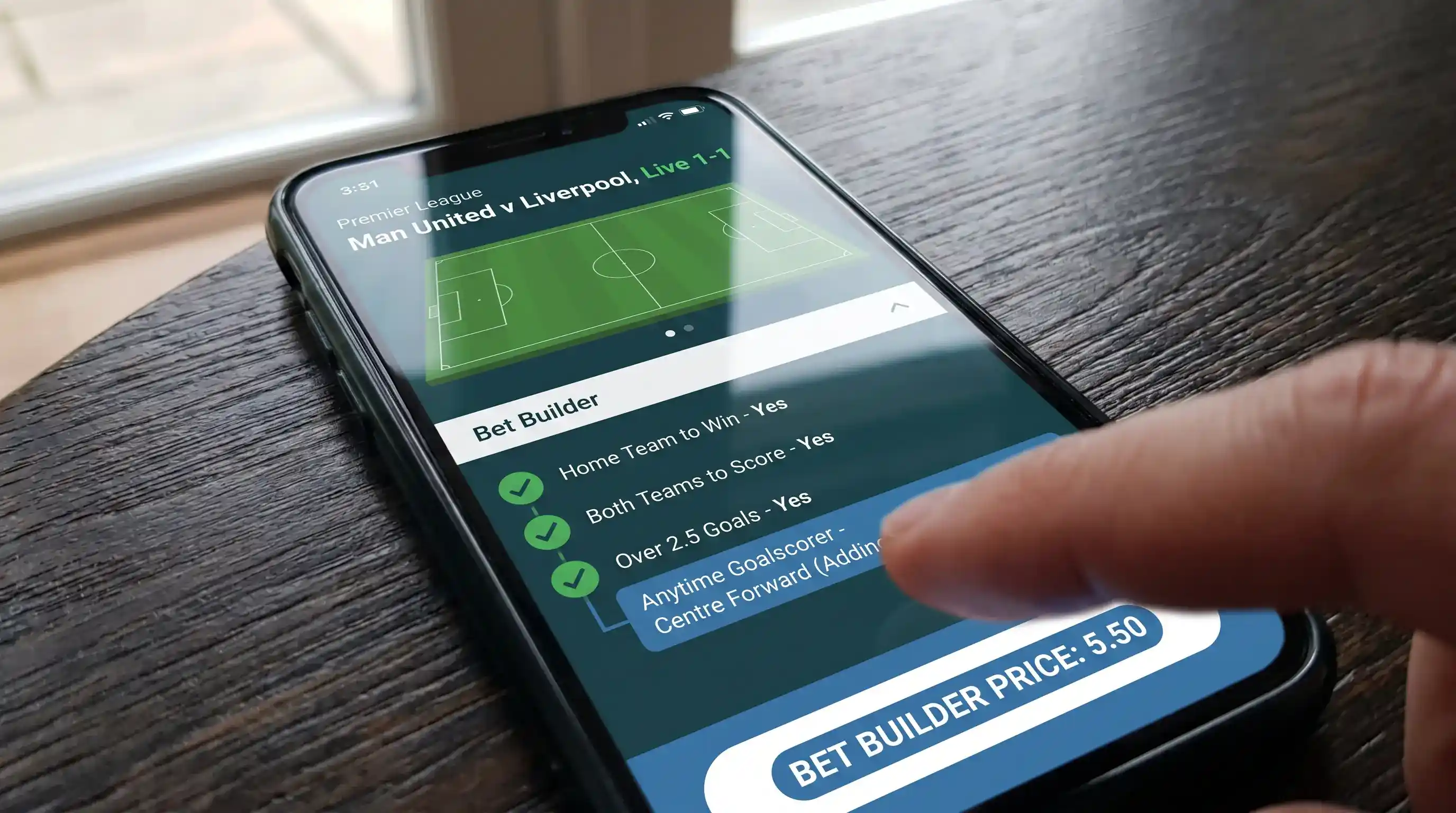
The most common Bet Builder slip in the UK Premier League market is the “favourite to win, both teams to score, over 2.5 goals” combination. Every weekend, across every leading UK app, this exact slip is the highest-volume same-game multi. The combination is positively correlated on all three pairs — favourite winning correlates with at least one goal scored, BTTS correlates with over 2.5, favourite winning is statistically associated with over 2.5 in matches where the favourite is meaningfully stronger — and the Bet Builder engine prices it accordingly. The fair price after correlation runs roughly twenty to twenty-five percent shorter than the product of the marginal prices.
The second most common pattern is the “anytime goalscorer plus result” combination — a specific player to score anytime combined with their team’s match result. This is positively correlated, and the size of the correlation depends on the player. A central forward on a strong home favourite is highly correlated — the team is more likely to win if the forward scores. A wide player on the same favourite is correlated less, because the team can win without the wide player scoring. The operator’s engine knows the difference, and the price tag varies by player position even on identical marginal odds.
The third pattern, which has grown faster than the others through 2024 and 2025, is the multi-leg cards-and-corners combination — over 4.5 cards combined with over 9.5 corners, sometimes with a player to be carded layered in. The legs here are positively correlated through match intensity: high-tempo, contested fixtures produce more cards and more corners simultaneously. The engine prices the correlation, and the resulting Bet Builder slip prices materially shorter than the naive product. This is the area where some operator engines are most aggressive, because the underlying correlation model is most uncertain and the operator’s margin sits on top of that uncertainty.
The fourth pattern is the lower-volume but higher-edge “anti-correlated” slip — backing a draw combined with both teams to score, for example. The two events are positively correlated (draws often involve goals), and the slip prices the correlation in. A more rewarding anti-correlated construction is “the underdog to win combined with under 2.5 goals”, which captures the cleanest mechanism in football: underdog wins are typically low-scoring, often 1-0 or 2-1. The Bet Builder engine prices this in, but in my experience the prices on these structurally underdog-low-scoring combinations are sometimes slightly looser than the prices on the favourite-high-scoring combinations, because the popular flow does not concentrate on them.
This is not a recommendation to chase niche slips. It is an observation that the Bet Builder market in the UK is heavily shaped by the popular flow, and the operator’s pricing is tightest where the punter demand is heaviest. Where the demand is lighter, the prices are not necessarily looser — but the asymmetry is real and worth knowing.
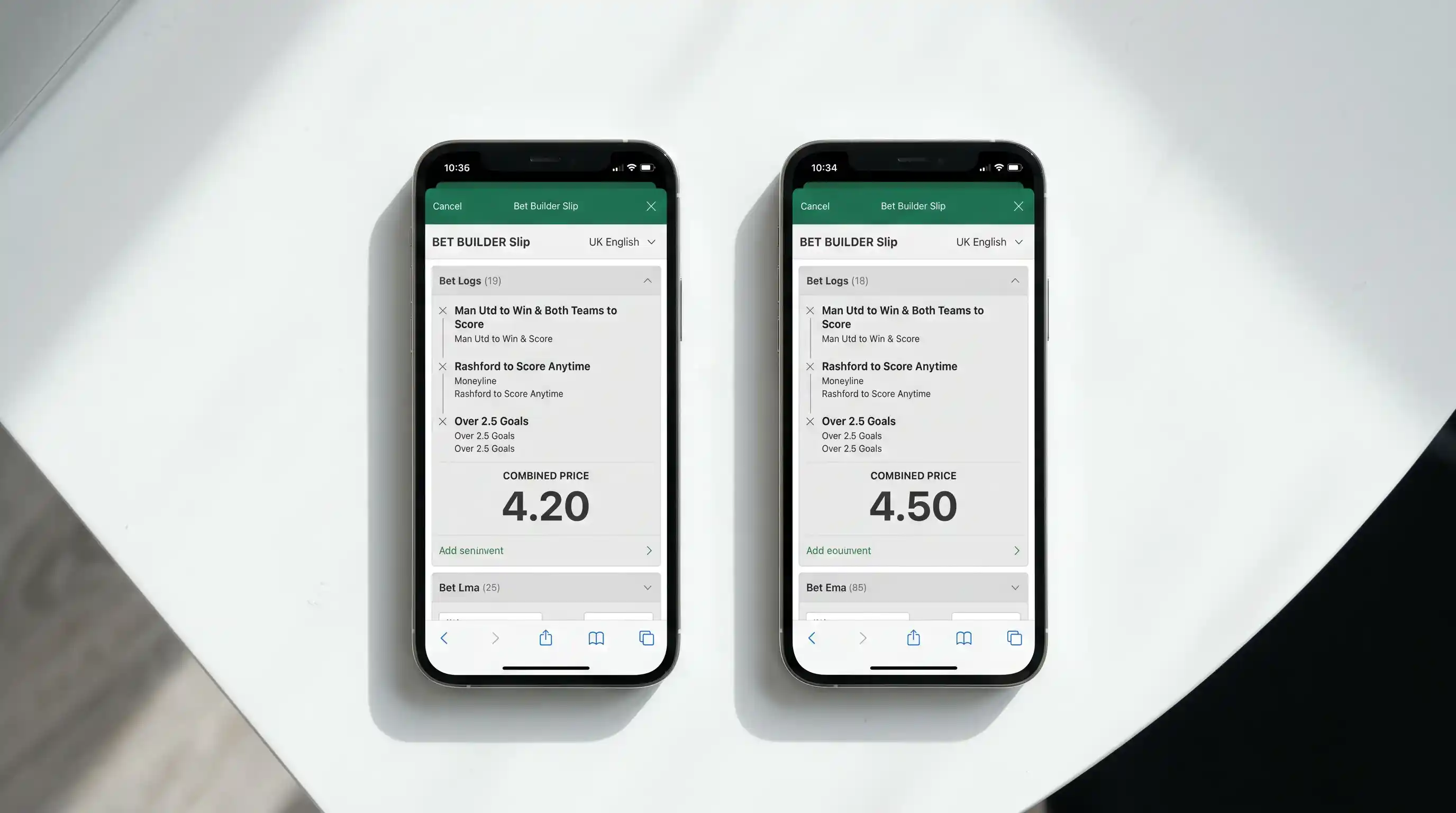
Why two operators price the same bet builder differently
Construct an identical Bet Builder slip at three UK operators on the same Saturday morning, and you will rarely get the same price three times. The differences are not random. They reflect three things: the underlying match model, the correlation model, and the operator’s chosen margin on the assembled product.
The underlying match model is the same engine that prices the pre-match singles. Each operator runs their own model, fed by their own data inputs and tuned by their own trading team. Two UK operators can both price Manchester City to win at 1.50 yet disagree on the probability of over 2.5 goals in the same fixture, because the goal-rate component of the two models is calibrated differently. The Adthena PPC data from early 2026 — William Hill at 37.83 percent of UK sports betting click-through, bet365 at 16.2 percent — reflects two operators whose pre-match models have been calibrated through trading-floor experience over decades, and the differences are visible to anyone who shops prices across the market.
The correlation model is where the divergence between operators becomes much wider on Bet Builders specifically. The pre-match singles can be compared directly across operators — same market, same outcome, different price. The Bet Builder correlation model is a private layer at every operator, and it is calibrated against historical data, against current trading desk intuition, and against the operator’s risk appetite on assembled products. Two operators can agree exactly on the marginal probabilities of three legs and still disagree by ten percent on the joint price, because their correlation models output different joint distributions.
Andreas Krannich, the executive vice-president for integrity services at Sportradar, recently made the broader point about live football data: the relative stabilisation of suspicious match numbers in 2025, he said, reinforces the importance of continued vigilance, with sustained investment in technology, intelligence, education and collaboration as essential. He was talking about match-fixing detection, but the underlying point — that the quality of a football pricing model depends on the quality of the data ecosystem it sits inside — applies equally to Bet Builder correlation. The operators with the largest active customer bases — and the Gambling Commission’s industry data shows 13.5 million active monthly accounts at the largest UK operators by March 2025 — have the deepest internal correlation data and tend to run the tightest joint pricing.
The operator’s margin is the third lever. Most UK books run a slightly higher margin on Bet Builders than on equivalent singles, on the logic that the assembled product is less price-comparable across operators and therefore less competitively constrained. The size of the extra margin varies: at the most competitive operators it is one to two percentage points above the singles margin; at the more aggressive operators it can be five percentage points above. Shopping the same Bet Builder across two or three operators is the cleanest way to see this — the spread on identical slips, calibrated for differences in the marginal singles, is the visible Bet Builder margin spread.
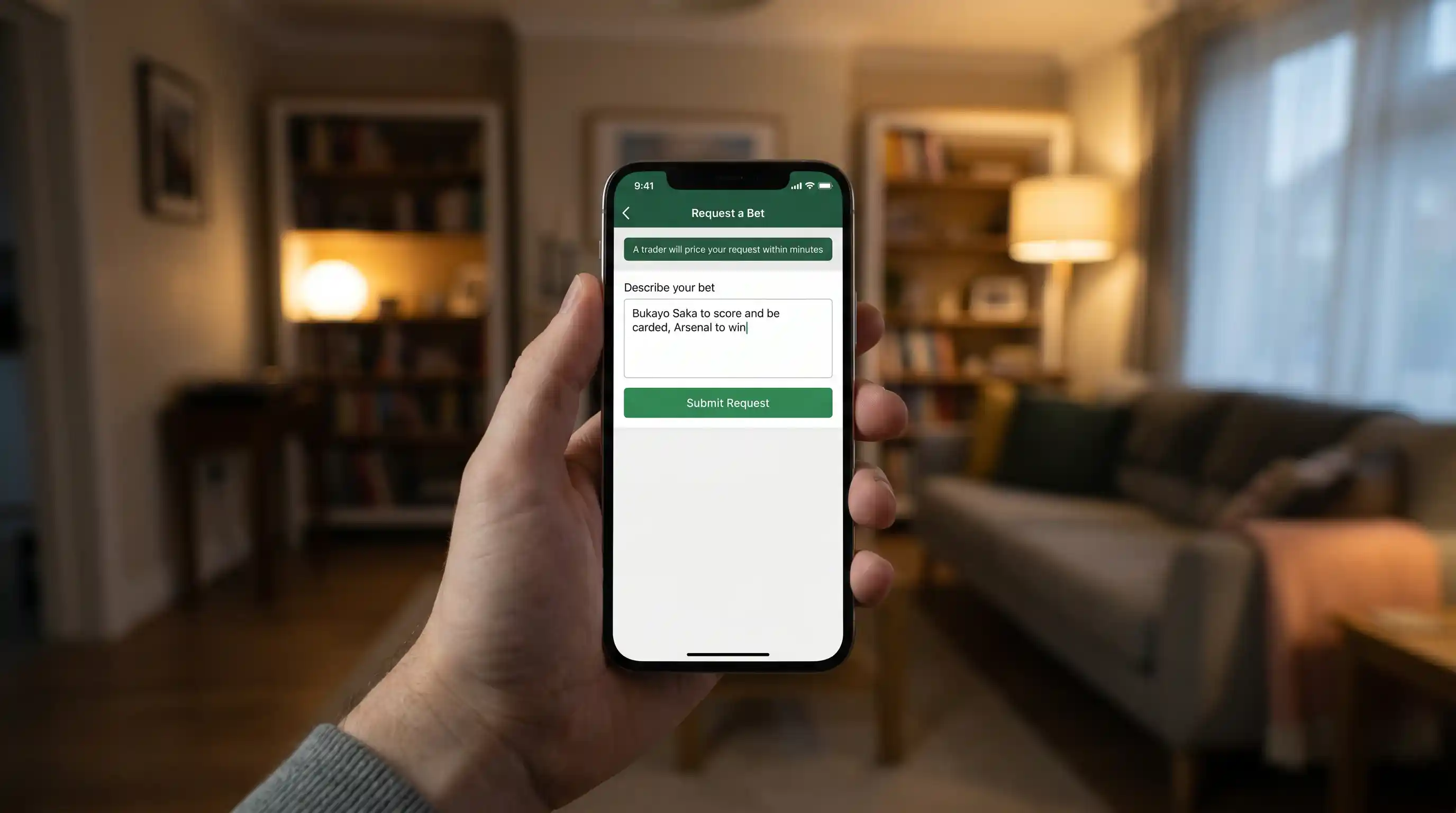
“Request a bet” services and human-priced markets
“Request a bet” sits adjacent to the Bet Builder product on most UK apps, and the two are often confused even though they operate on completely different pricing mechanics. Request a bet is the human-priced cousin of the algorithmically-priced Bet Builder, and the difference matters more than the menu placement suggests.
A request-a-bet market is constructed when a punter requests a specific combination that the Bet Builder engine does not automatically support. The request goes to a human trader, who prices the combination by hand — sometimes within seconds for liquid requests, sometimes within minutes for unusual ones — and the punter accepts or declines the offered price. The trader is working from the same underlying match model as the Bet Builder engine but is applying judgment to combinations the engine has not been pre-calibrated to handle.
The most common request-a-bet markets are player-specific multi-leg combinations: a named player to score, to be carded and to have over a certain number of shots, all in the same match. The Bet Builder engine struggles with these because the joint distribution depends on individual player data the engine does not necessarily ingest at the resolution needed. A human trader, by contrast, can build the joint distribution from a more flexible mental model and price it within an acceptable range.
The trade-off for the punter is that human pricing usually carries a larger margin than algorithmic pricing — the trader builds in a buffer for the uncertainty in their own price — but in exchange the punter accesses combinations that the engine simply will not offer. For the casual punter, the most useful framing is that request a bet is the right tool when you have a specific narrative in mind that the Bet Builder cannot accommodate, and the wrong tool when the same combination is already available in the standard Bet Builder menu.
Cash-out on a same-game multi: what gets withheld
Cash-out on a Bet Builder is the single feature of the product where the gap between visible price and fair value is largest, and where I would push back hardest against accepting the offered figure without thinking it through. The mechanic is simple, the maths is not.
A cash-out offer on a Bet Builder is the operator’s quote to buy back the slip at its current implied value. The implied value depends on which legs have already settled, which legs are still live, and the current market price of the still-live legs. The operator’s pricing engine calculates the fair value of the slip, applies a margin — typically materially larger than the margin on the original slip — and presents the cash-out figure to the punter. The size of the additional margin is the key number, and it is the number the punter cannot see.
The operator’s logic is defensible. The cash-out market is, from the operator’s perspective, a sequence of bilateral transactions in which the punter holds asymmetric information about whether they want to keep the position. A punter who chooses to cash out is, on average, more risk-averse on this specific slip at this specific moment than the operator. The operator pays for that asymmetry through the extra margin in the cash-out price.
Partial cash-out — the option to take some of the value off the table while leaving the rest of the position live — runs on the same mechanic with the same extra margin. Auto cash-out, which triggers a cash-out automatically when the offered figure reaches a level you have set in advance, has the additional latency risk of the trigger firing on a price that has moved between your target setting and the actual execution.
The defensible rule on Bet Builder cash-out, in my experience, is to treat the offered figure as a benchmark, not as a fair price. If the cash-out value is materially higher than your own estimate of the slip’s fair value, take it. If it sits at or below your own estimate, hold. If you cannot form your own estimate, you are not in a position to evaluate the cash-out offer at all, and the safer move is usually to leave the slip alone and let it settle.

Three quick tests before you confirm a bet builder slip
The end-of-flow checklist I run on my own Bet Builder slips is short, deliberately, because long checklists fail in practice. Three tests, each taking under a minute, applied to every slip before I tap “place bet”.
Test one is the correlation direction test. I look at the legs I have selected and ask, in plain English, whether they go together or work against each other in football logic. If they go together — favourite plus high goals, BTTS plus over 2.5, intensity plus cards plus corners — the price the engine has offered me should be materially shorter than the product of the marginal prices, and if it is not, the engine has either missed something or is offering an unusually loose joint price. The first possibility is rare; the second is worth taking advantage of.
Test two is the marginal price test. I check each leg of the slip against the singles market at the same operator and across one or two competing UK operators. If any leg is priced more conservatively in the Bet Builder than the same leg is priced as a single at the same operator, the engine is rebasing the marginals upward — sometimes legitimately, when the singles price is being held against a sharper market price, sometimes less legitimately, as a quiet margin grab. Either way the rebase is information about how the operator is treating my slip.
Test three is the alternative-product test. I ask myself whether the same notional position could be expressed more efficiently as a single bet plus a single side bet, rather than as a combined Bet Builder. Sometimes the answer is yes — a Bet Builder of “Manchester City to win + over 2.5 goals” can be replaced by two separate singles at a lower combined margin, with the trade-off that I lose the all-or-nothing structure of the assembled slip. For many punters the all-or-nothing structure is the appeal of the product, and the slightly higher margin is a price worth paying. But the question is worth asking once on every slip, because the answer is not always the same.
Three tests, ninety seconds, on a product that exists because British punters wanted control over their slips and operators figured out how to give them that control profitably. The Bet Builder is not a worse product than the accumulator — it is a different product, with a different maths, that pays for its flexibility with a tighter joint pricing. The work I have outlined is the work that closes the gap between using the product casually and using it well.
Frequently asked questions
Why does my Bet Builder slip pay less than the implied multiplied price?
Because the legs in a Bet Builder are correlated, and the price reflects the joint probability of all legs winning simultaneously rather than the simple product of the individual prices. When you combine a home favourite with over 2.5 goals, for example, the two outcomes are positively correlated — a favourite winning often involves goals, and a high-scoring match makes the favourite more likely to win. The fair price of the joint outcome is shorter than the product of the marginal prices, sometimes by twenty to thirty percent before the operator"s margin is added on top. The Bet Builder engine knows this; the price you see is the engine"s estimate of the correlation rather than a naive multiplication.
Can I add legs from two different football matches to the same Bet Builder?
No, by definition. The Bet Builder is a same-game multi product — every leg must come from the same fixture, because the whole pricing model depends on the correlation structure within a single match. To combine legs from different matches you need an accumulator, which treats the legs as statistically independent and prices accordingly. Some UK operators offer a hybrid product where you can combine a single Bet Builder slip with one or more separate match singles into a larger multi — sometimes called "Acca Builder" or "Multi-Bet Builder" — but the legs within each Bet Builder block must still be from the same match.
Will cash-out on a Bet Builder always be lower than the live theoretical value?
In almost every case, yes — and the gap is generally larger than the cash-out gap on a single bet. The operator"s cash-out engine prices the slip at its current implied fair value and then applies a margin on top, and that margin is materially larger on Bet Builders than on singles because the operator is buying back an asymmetric position from a punter who has chosen the moment of the transaction. The practical rule is to treat the cash-out figure as a benchmark rather than a fair price: if it materially exceeds your own estimate of the slip"s value, accept it; if it sits at or below your estimate, hold the position and let it settle.
This material was created by the Pitchledger team.
