

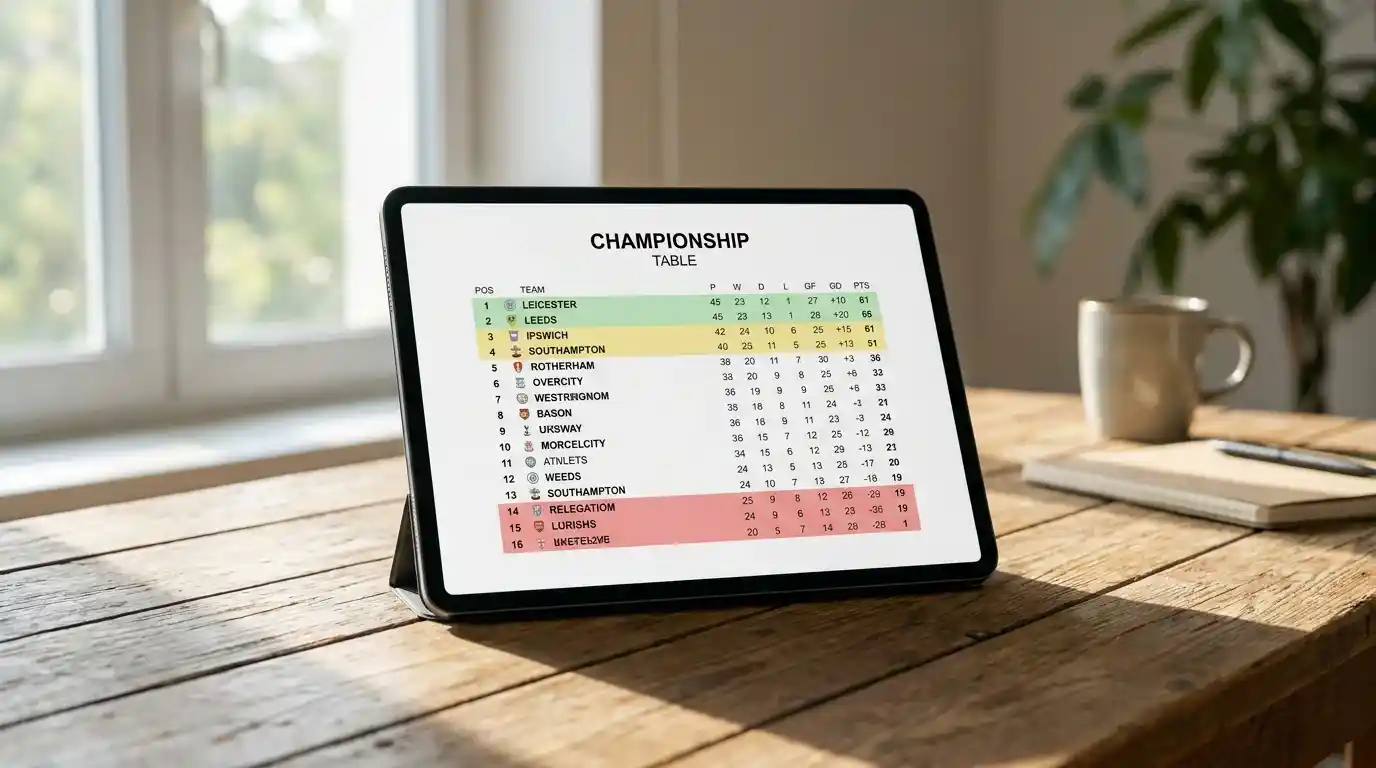
Why the Championship is the UK’s second-most-bet league
People underestimate what the Championship is. They look at the Premier League’s marketing apparatus and assume the second tier sits somewhere in its shadow. Then they look at the betting turnover and the picture changes. The Championship is the second-most-bet league in UK football by some distance, and it carries weekly turnover patterns that operators take just as seriously as the top flight.
The reason is volume. The Championship plays 46 league matches per club across a 10-month season, plus play-offs. That’s 552 league fixtures plus another six matches for the play-off final and semi-finals. Compare to the Premier League’s 380 league fixtures and you start to see why the Championship contributes meaningfully to the £1.3 bn of football GGY that UK remote betting produced in the year to March 2025. More matches, more markets, more turnover — even if individual match handles are smaller than the Premier League.

Promotion, automatic and play-off markets
The marquee Championship outright market is the season-long promotion structure. Two clubs go up automatically — first and second — and the third promotion spot comes through the play-offs between the four clubs finishing third to sixth. UK operators carry separate outright markets on each layer: title winner, top two finish, top six finish, and play-off winner.
The top-two finish market is the structurally most interesting of the four. Top-two betting carries 110% to 113% overround at major UK operators — wider than Premier League title outrights but narrower than Premier League top-four because the field is more competitive. The probability that any given top-six club finishes top two varies enormously by season, and the prices move dramatically through the autumn as form establishes itself.
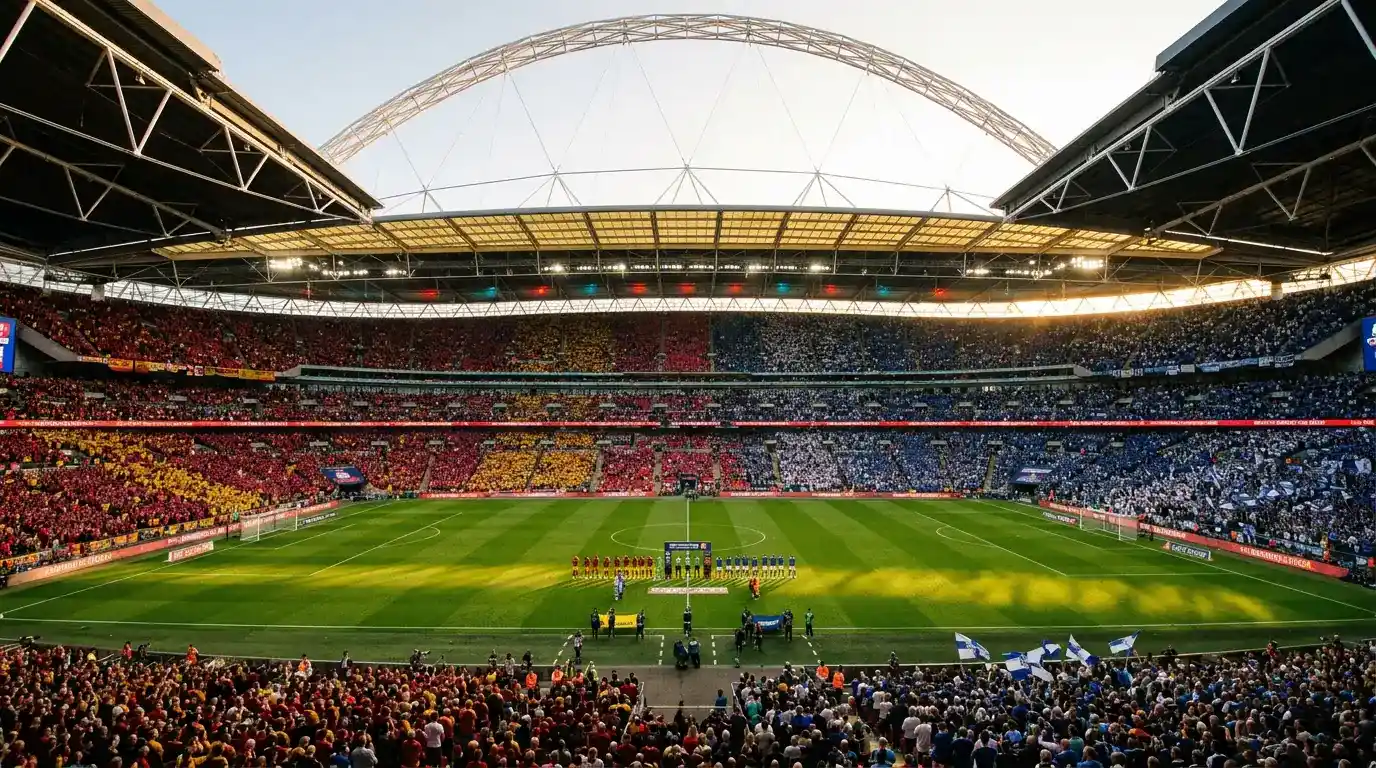
The play-off winner market is the highest-variance outright product in the UK football calendar. Four clubs go in, one comes out, and the format introduces a single-leg final at Wembley that’s notoriously hard to predict. Operators price the play-off final favourite typically at 6/4 to 13/8, with the other finalist around 5/4 to 6/4 the other way. The market is at its sharpest in the 48 hours between the semi-final second legs concluding and the final kicking off.
Relegation outrights run parallel and carry similar mechanics in reverse. The bottom-three finish market is the relegation equivalent of top-six and runs about 108–110% overround.
The Saturday three o’clock cycle and price drift
Saturday at 3 p.m. is the Championship’s natural state. Most Championship rounds put 10 to 12 matches on the 3 p.m. slot, with one or two midweek lunchtime kicks-off and a Sunday afternoon broadcast match. The 3 p.m. mass card is where most of the weekly turnover lives.
Price movement through the week follows a different pattern from the Premier League because trader attention is more dispersed. A Premier League fixture gets a dedicated trader from Monday onwards; a Championship fixture might share trader bandwidth with five other matches. The result is that prices on individual Championship matches drift more between opening and Saturday morning than equivalent Premier League prices.
The genuine value windows in the Championship sit in two places. First, Friday-evening prices on the smaller Saturday 3 p.m. fixtures — the trader floor is processing the headline Premier League fixtures for that night’s matches and the Championship Saturday mass card gets less attention. Second, midweek prices on rearranged Championship matches — fixture congestion creates pricing inefficiencies that don’t appear in the standard Saturday window.
Live in-play markets on Championship matches run at slightly wider margins than Premier League equivalents — typically 4–6% wider on 1X2 and 5–8% wider on goals markets. The trader’s information disadvantage on the Championship is real and the overround compensates for it.
Midweek fixture volatility and turnover spikes
Tuesday and Wednesday Championship rounds — what the league calls “regular midweek” rounds, distinct from rescheduled fixtures — create distinctive market behaviour. Operators see lower turnover than Saturday rounds (the casual punter base engages less with midweek), but the punter mix shifts toward more serious bettors who know the league well.

That mix shift affects pricing in two ways. Margins on midweek 1X2 markets are similar to Saturday because the operator’s structural overhead doesn’t change, but the price-discovery rhythm is different. Sharp money lands earlier in midweek windows because the bettors who turn up are more sophisticated, and the prices settle faster. By Tuesday lunchtime, the midweek round prices are largely set; by Friday lunchtime on a Saturday card, the prices are still moving.
The other midweek phenomenon is the rotation effect. Championship clubs in cup competitions (Carabao Cup, FA Cup) face fixture congestion that the Premier League’s deeper squads insulate against. A midweek Championship round following a Tuesday-night cup tie produces meaningful rotation, and the operator’s pricing model has to anticipate it. Late line-up news on these midweek rounds moves prices more than equivalent Premier League rotations.
The Sky Bet title-sponsorship context
The EFL’s title-sponsorship arrangement with Sky Bet runs through to 2029. The Championship, League One, and League Two all sit under the Sky Bet umbrella — and that arrangement sits explicitly outside the Premier League’s voluntary front-of-shirt gambling sponsorship ban, which takes effect from the start of the 2026/27 season.

The asymmetry is notable. Premier League clubs are removing front-of-shirt gambling sponsorship — 11 of 20 PL clubs carried gambling brands as front-of-shirt sponsors in the 2025/26 season, all of which transition out by August 2026. Meanwhile, the EFL maintains its title sponsor through every weekend match across all three divisions until at least 2029.
The implication for the Championship punter is structural rather than tactical. Sky Bet’s marquee position in the league’s commercial infrastructure means the operator front-pages Championship coverage more aggressively than competitors — Request a Bet markets, custom promotions, deep streaming. The pricing on Sky Bet’s Championship markets isn’t structurally tighter than competitors, but the product depth and promotional cadence is. Punters serious about Championship betting tend to maintain accounts at multiple operators specifically to capture price differences across the league.
Where to find tighter Championship prices in 2026
Price-shopping in the Championship is meaningfully more valuable than in the Premier League because inter-operator price variance is wider. A typical Championship 1X2 might price at 2.10, 3.30, 3.40 at one operator and 2.05, 3.40, 3.50 at another — a meaningful spread on the same fixture.

The operators with the tightest Championship books tend to be the ones with strong domestic UK retail businesses — the marketing scale supports the trader investment in domestic football specifically. International operators carry the Championship but tend to spread their trader attention across more leagues, which leaves the books slightly wider on individual fixtures.
The play-off final at Wembley is the one Championship fixture that prices to Premier League standards. Trader attention concentrates, retail flow is heavy, and the books tighten to 103–104% overround on 1X2. The semi-final two-legged ties carry intermediate tightness — wider than the final, tighter than regular-season fixtures.
The Championship sits inside a broader EFL ecosystem that also includes the FA Cup, which Championship clubs participate in alongside top-flight opposition. The cup tie pricing introduces a different set of structural quirks — rotation, magic-of-the-cup variance, asymmetric line-ups — that pair with Championship knowledge to produce useful betting opportunities. My breakdown of FA Cup betting at UK bookmakers covers how those cup-tie patterns intersect with Championship form reading.
The league that rewards patient market-reading
The Championship is the cleanest league in UK football for the patient analytical punter. Prices drift more, markets are softer, retail flow is less dominant, and the trader’s information disadvantage is more pronounced. None of those factors make the Championship easy to beat — but they make it possible to find genuine value if you’re willing to do the form work that the casual market doesn’t.
The 46-match season also produces sample size advantages that the 38-match Premier League doesn’t. By December, you have enough fixture data to identify clubs whose underlying performance is meaningfully different from their league position. By February, you can build outright positions on clubs whose play-off probability is mispriced. The work is harder than Premier League betting because the data quality is lower, but the reward for doing the work is higher because the markets reflect it.
Why do parachute-payment clubs price shorter for promotion than form suggests?
Operators load patriot-flow weight onto recently-relegated Premier League clubs across the autumn months. The reasoning is partly squad quality (genuinely superior to most of the Championship) and partly that retail flow concentrates on these clubs because they"re familiar. Mid-season, the price often overstates their probability by 5–10% — a small but persistent edge for fading them at the right point.
Does Sky Bet always lead the promotion market?
No. Sky Bet carries deep Championship coverage and aggressive promotional positioning, but its 1X2 and outright prices on Championship markets aren"t structurally tighter than the major competitors. Price-shopping across two or three UK operators on every Championship outright is the right discipline regardless of brand.
Are Best Odds Guaranteed offers on Championship outrights common?
Yes. BOG on Championship promotion outrights and play-off winner markets is widely available at major UK operators. The qualifying-cut-off rules differ between operators — some use late-season fixture rounds, others use a calendar-day reference. Check the specific BOG terms before assuming the offer applies.
This material was created by the Pitchledger team.
