


Why tournament betting punishes club-football instincts
The first World Cup I priced trades on was 2010 South Africa. Going in, I had a clean view of the European clubs every starting XI had come from. By the second round of group games I’d been humbled three times — Spain losing to Switzerland, France imploding against South Africa, England drawing with Algeria. Club form had told me almost nothing about how those national sides would actually play together.
That tournament rewired how I think about international football. The instincts that work brilliantly for the Premier League stop working at international level. Tournament betting needs a different lens, and the bookmakers know it — which is why outright tournament prices look so different from what your club-football reflex tells you they should be.
Outright winner markets and the home-nation distortion
Outright tournament winner is the marquee market for World Cups and Euros, and it carries a peculiar bias: home nations and historically successful nations are systematically over-bet by retail punters. The bookmaker accounts for that by holding the favourite’s price slightly longer than the pure model would suggest, knowing that retail money will pour in regardless.

The implied probability in a tournament outright market for the top three favourites usually sums to about 45-55% — Brazil at 5/1, France at 11/2, England at 13/2 would imply 16.7% + 15.4% + 13.3% = 45.4% combined. Add the next three or four contenders and you’re at 70%. That leaves 30% of probability spread across 24 other nations, which is structurally where punters who do the work find their value. A nation priced 33/1 with a 3.5% true probability is offering a 17% edge.
Tournament outrights also carry the longest hold periods in football betting. From the moment the qualification draw is made through to the final whistle of the final, that’s two to three years. UK gambling generated £2.6bn in remote sports GGY across all sports last year, and a meaningful share of that comes from money locked up in tournament outrights for months at a time. Bookmakers love these markets because they generate slow, steady margin.
Group stage tactics and the structural draw bias
Group stages are where international tournaments hand out free lessons in how the format itself shapes outcomes. Three games, top two advance, goal difference often the tiebreaker. That structure changes how teams play in their third group game in ways that don’t appear in any other football competition.
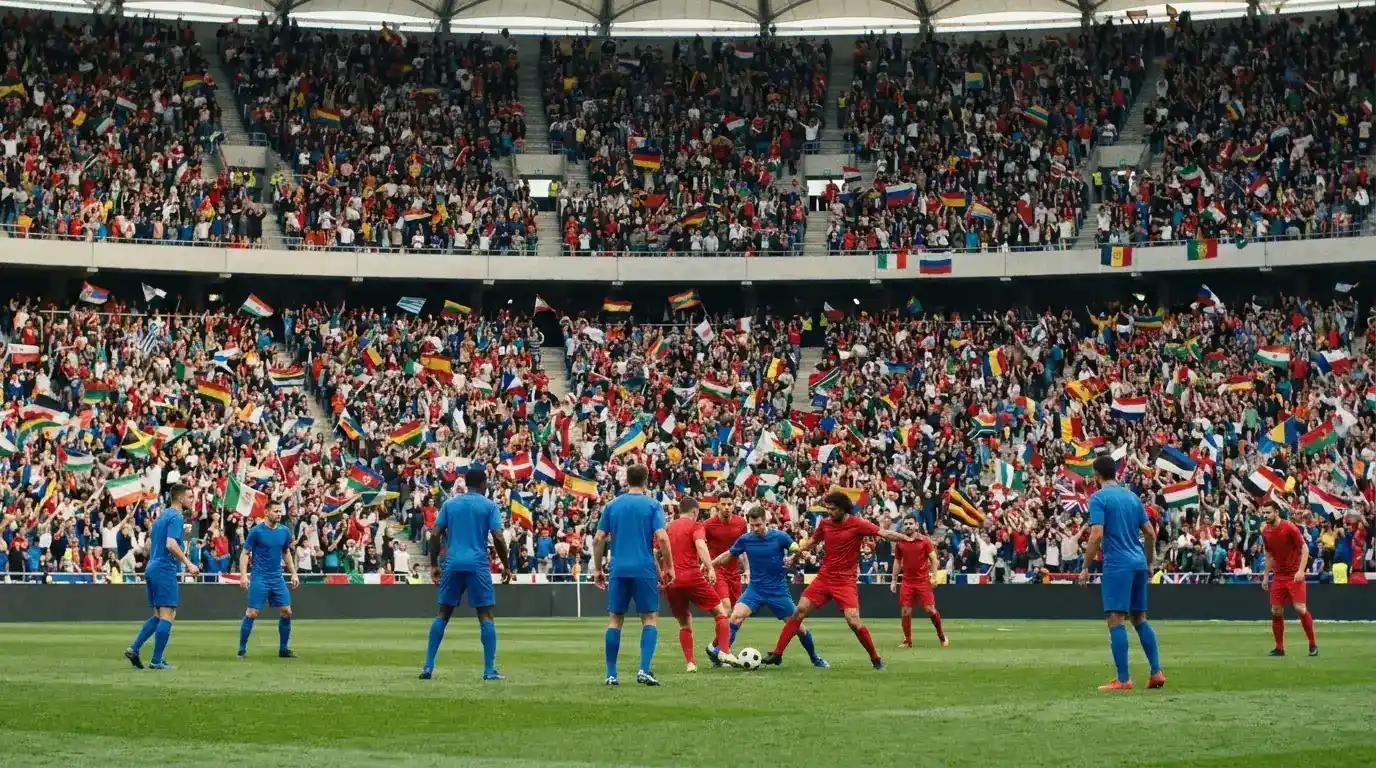
The classic example: a team going into the third group game knowing a draw qualifies them. Their incentive to attack drops sharply. The opponent’s incentive depends on their own position. The match often becomes a controlled draw, and the under 2.5 goals line at 4/5 becomes effectively a coin flip with a built-in bookmaker edge.
I’d avoid the under 2.5 line on these “controlled” final group games and instead look at the draw market, which is often priced 5/2 to 11/4 when the implied probability of a draw given the incentives sits closer to 35-40%. That’s a clearer route to the same underlying view.
Group betting offers cleaner markets than outrights. “Group winner” and “to qualify” both let you isolate a single nation without paying for the full tournament path. They also tend to carry tighter overrounds — usually 104-106% — because the field is small and the bookmaker can model six games more precisely than the full 64.
Goalscorer markets and the international striker premium
Top goalscorer at a tournament is one of the most consistently mis-priced markets in football betting, in both directions. Retail flow concentrates on three or four superstars, which keeps their prices artificially short. The mid-tier — striker at a strong team priced 16/1 to 25/1 — is where value usually sits, because these are the players who’ll play four to seven games and could realistically score five or six goals if their team progresses.
The mathematics are simple. A tournament-winning side plays seven games. Their starting striker is likely to take 70-75% of those 90 minutes. If that striker is averaging a goal every 130 minutes for their national side, they’re expected to score around 3.5 goals across the tournament. A field of 32 nations contains maybe ten strikers in similar territory, and the actual top scorer is usually one of those ten.
Pricing one of those ten at 20/1 implies 4.8% probability when 10% is closer to fair. That’s the kind of structural edge that disappears the moment you start betting club football, where individual players’ minutes are highly variable and rotation is constant.
The way these long-form outright markets sit alongside ongoing match-by-match betting through a tournament is also where the UK industry’s responsible-play infrastructure gets visible — UK gambling pulled in £1.3bn in football GGY last year across all formats, and the share that comes from tournament weekend volumes is precisely where operators emphasise tools like deposit limits, session reminders, and self-exclusion. The Betting and Gaming Council’s pre-tournament messaging usually centres on the line that responsible operators put protection ahead of volume, and Grainne Hurst, who runs the council, framed the point as the industry’s standing position: regulated operators must compete on safer-gambling standards as visibly as they compete on prices.
In-play tournament markets and the rest-day rhythm
Tournament football has a rhythm that club football doesn’t: every team gets two to three rest days between group games, four to five days between knockout fixtures. That rhythm changes how teams play late in matches. Players run further and press harder than they would in a midweek Premier League fixture.

That late-match intensity shows up in the goal distribution. Tournament games average more goals in the final 15 minutes than club football equivalents. The in-play over line typically prices 2.5 goals at evens with five minutes left and the score at 1-1, whereas the equivalent Premier League situation might be 11/10 or longer. The market is pricing the expected late-tournament push.
This is where in-play tactics for tournament football diverge from in-play tactics for club football. You’re not just trading momentum within a single match — you’re trading the structural fact that tournament players have more left in the tank at minute 80 than club players do.
Where the UK regulator’s tournament focus lands
The Gambling Commission has been increasingly active around major tournaments in recent years, particularly on advertising restrictions, in-play betting prompts, and operator marketing during fixtures involving home nations. The 2026/27 Premier League season will bring front-of-shirt sponsorship restrictions, and the same regulatory direction is informing tournament-time conduct: less aggressive in-play prompting, clearer messaging around responsible play, tighter rules on bonus structures targeted at first-time depositors during marquee fixtures.

For the punter, that means tournament-weekend bonuses are more conservative than they were even three or four years ago. The “double winnings if your team wins” offers that used to flood social feeds during a World Cup semi-final are now subject to far stricter promotional rules. The headline numbers look smaller; the underlying value is roughly the same, just better-disclosed.
What a tournament’s worth as a learning environment
A World Cup or Euros gives you 64 to 81 matches in a four-week window across 24 to 32 nations playing every format from open to defensive to chaotic. That’s the densest concentration of varied football you’ll get in the calendar.
The punters who profit through tournaments tend to share one habit — they take notes during the group stages on team approach, manager decisions, and individual standout players, and they apply those notes to the knockout-round markets where the bookmaker has less time to update prices between fixtures. The information edge is real and it’s available to anyone watching attentively. The tournaments reward attention in a way the club calendar simply doesn’t.

Why are tournament outright prices so resistant to early results?
Because tournament outright markets carry months of locked-in money. A favourite"s price will adjust on results, but slowly — a single group-stage stumble might shift England from 5/1 to 7/1 rather than 5/1 to 10/1, because the bookmaker has to absorb the existing book of bets, not just price the next event.
Are top goalscorer markets really better value in the mid-tier?
Generally yes. Retail flow concentrates on three or four superstars at single-digit prices. Strikers in the 16/1 to 25/1 range at strong, deep teams often offer 30-50% better implied probability than the price suggests, because they"re attached to teams likely to play six or seven games.
Should I bet group stage outcomes or wait for knockout rounds?
Group stages reward research more than knockouts. The bookmaker has limited model time per fixture, and team news is harder to source. Knockouts price tighter because the bookmaker has seen the team play three games already. Most value lives in group stages and especially in the second and third group game.
This material was created by the Pitchledger team.
