

Cash-out reframes a live bet as an option you can sell back
The first time I built a live valuation model for a Saturday card, I sat watching a 1-0 lead become a 1-1 in seven minutes and the cash-out value on a pre-match home win drop from £14 to £4.20. The bet hadn’t lost. The match wasn’t over. The probability of the original outcome was just being re-priced second by second, and the operator was happy to buy the bet back from me at a deeply unflattering price.
That’s the whole story of cash-out. You haven’t bought a bet. You’ve bought an option to sell that bet back at whatever the operator’s live valuation says it’s worth. The button is constantly available, the price moves constantly, and the operator earns a small margin on every transaction. UK remote sports betting produced £2.6 bn in GGY last year, and the cash-out mechanism has quietly become one of the more profitable single features on every UK app.
How the sell-back price is calculated
The mechanic is simpler than the UI suggests. At any moment in a live match, the operator computes the implied probability that your original bet will eventually win based on the current state of play. That probability is multiplied by your potential return to give the theoretical value of the bet right now. The cash-out price you see is that theoretical value minus the operator’s margin.
Picture a £10 bet on a home win at decimal price 3.00. Your potential return is £30. The match is 1-0 to your team at half-time. The operator’s live model says the home side now wins 72% of the time from this position. Theoretical value: £30 × 0.72 = £21.60. The operator’s cash-out margin on this market might be 4%, so they quote you about £20.74 to sell back. Take it, and you’ve banked £10.74 of profit on a bet that hasn’t yet resolved.

The accuracy of the underlying model depends entirely on the data feed feeding it. Live football probability models are built on play-by-play data — possession, expected goals, shots on target, attacking-third entries, scoreline, time remaining, and a dozen other variables. The integrity of that feed matters. As Andreas Krannich, Sportradar’s executive vice president for integrity services, has put it: “The relative stabilisation of suspicious match numbers in 2025 is encouraging, yet it reinforces the importance of continued vigilance. Match-fixing remains an evolving threat, and sustained investment in technology, intelligence, education, and collaboration is essential.” That investment isn’t only about catching fixes — it’s the same data layer that lets a cash-out engine quote a price at all.
The hidden margin inside every cash-out quote
Operators don’t publish their cash-out margin. They don’t need to — the margin is structural in the quoted price, the way overround is structural in a 1X2 market. Reverse-engineering it isn’t hard.
Take a bet that’s now 50/50 to win. Theoretical value of a £30 potential return at 50% is £15. A typical UK operator will quote that bet back at around £14.10 to £14.50 — implying a cash-out margin of 3% to 6%. That margin is on top of the original overround you already paid when placing the bet. Cash-out is, in mathematical language, a second tax on the same wager.

Margins vary by market state. Cash-out margins tend to be tightest when probabilities are clear — say, you’re 80% likely to win — because the operator has less uncertainty to price. Margins widen when the probability is close to 50/50 because the operator’s downside if their model is wrong is higher. Margins are widest in volatile match states (1-0 with 15 minutes remaining, anything in stoppage time) because a single goal can move the probability by 30 percentage points.
The implication for the punter is uncomfortable. Cash-out is most expensive precisely when you feel most tempted to use it.
Partial versus full cash-out — and when partial works
Most UK operators now offer partial cash-out, where you take some money out and leave the rest of the bet running. The mechanic is simple — you sell back a percentage of the stake at the current quoted price, and the remainder of the original bet stays live until the match ends.
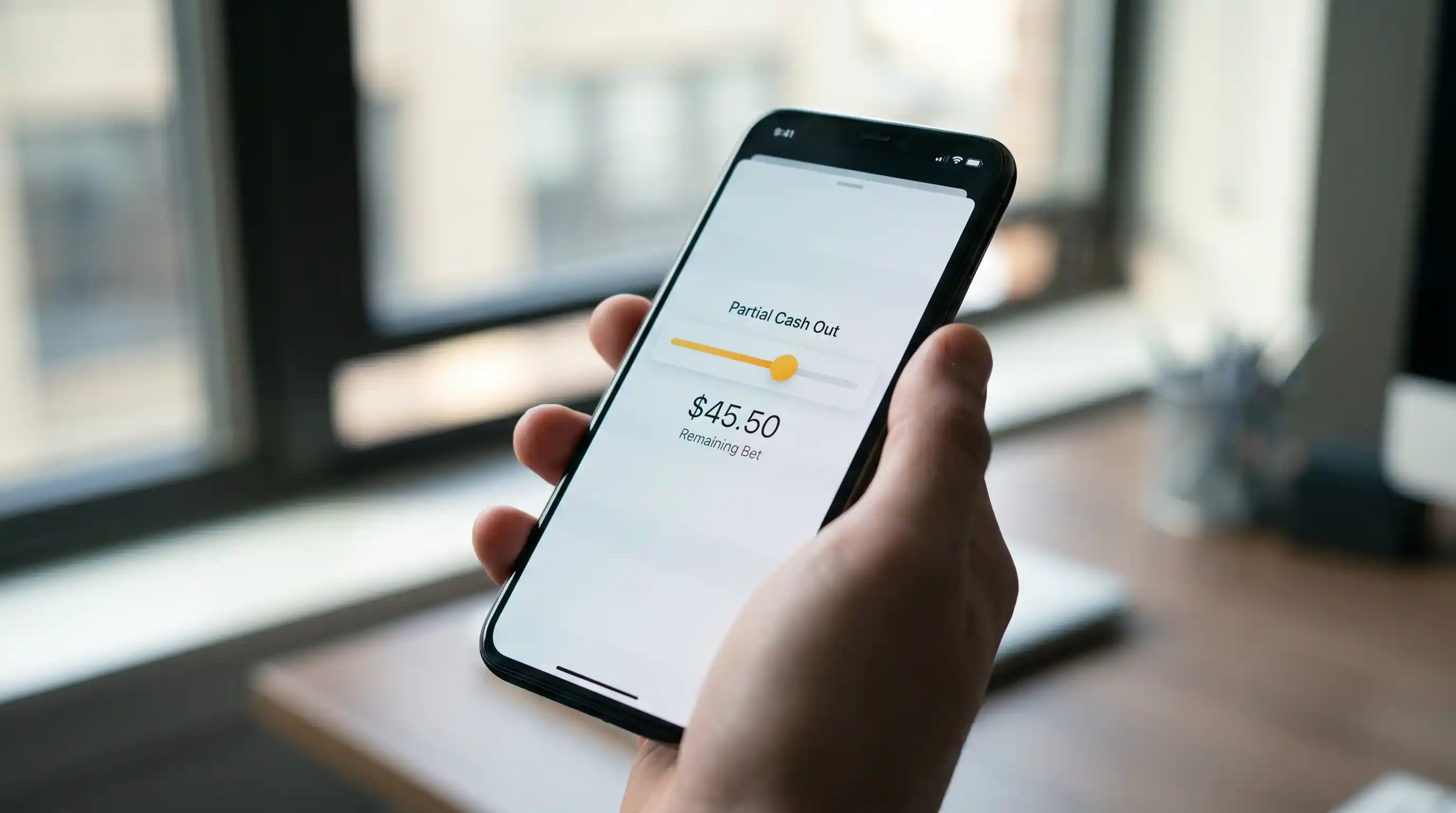
Partial works in two specific scenarios. First, when you want to lock in stake recovery — sell back enough of the bet to recover your original outlay, leaving a “free” residual position that pays out if the bet wins. Second, when the live cash-out price is unattractive but you want to reduce variance — selling back 40% protects most of the gain while leaving meaningful upside.
Full cash-out makes sense in only a narrow set of cases. The match state has shifted decisively in your favour, the quoted price is close to your theoretical maximum, and you simply want the money. Or — more commonly in practice — you’re emotionally done with the bet and would rather lock something than ride out 20 minutes of stress.
That second motivation is real and it’s not stupid. Variance is mentally expensive. If cashing out for £18 instead of holding for an EV of £21 means you sleep on Saturday night without checking the score every two minutes, that’s worth something. Just be honest about whether you’re making a value decision or a comfort decision. The operator’s product is happy to be either.
Auto cash-out — triggers, latency and slippage
Auto cash-out lets you set a target sell-back price in advance — typically a multiple of your stake — and the system fires the cash-out automatically when that threshold is hit. Useful in principle. Imperfect in practice.
The catch is latency. The auto-trigger fires when the operator’s quoted price reaches your target. That quoted price moves continuously, but it’s not a guaranteed price — it’s an offer the operator stands behind for fractions of a second. By the time the auto-trigger executes, the live state may have moved and the actual sell-back price may differ from the target. Slippage of 2% to 5% against your target is common when the trigger fires during a goalmouth scramble.

Live football participation is the largest in-play category in Britain — 5% of all adults engage with it, climbing to 9% of men. That scale means operator engines are processing huge volumes of auto-cash-out triggers simultaneously during a Premier League weekend, and the latency story compounds during peak load.
I’d set auto-cash-out triggers with a small buffer above the price I actually want. If I’d genuinely take £15 back on a £10 bet, I set the trigger at £15.50 to account for the slippage. The price doesn’t always slip the way you expect, but you’d rather miss a marginal trigger than execute at a price below your target.
When cash-out gets suspended and what to do
Cash-out availability is at the operator’s discretion, and the button can disappear at any time during a match. The most common trigger is market suspension — a goal, a red card, a penalty, a VAR review, or any other event the operator’s model can’t price in real time. While the market is suspended, cash-out is suspended with it.
The suspension typically lasts 30 seconds to two minutes — long enough for the operator’s data feed to update and the pricing model to re-stabilise. When the market reopens, the cash-out price will reflect the new state. Punters routinely complain about cash-out being “down” at exactly the moment they wanted to use it. The honest answer is that the moment you most want to use it is exactly the moment the operator least wants to quote you a price.
Other triggers for cash-out suspension include unusual betting patterns on the underlying market (integrity-related throttling), data feed failures, and operator-side technical issues. These are rarer but do happen during high-volume Saturday cards.
When cash-out is suspended, your options narrow to two — wait for the button to come back, or let the bet run to its natural conclusion. There’s no third option. The original bet can’t be voided, withdrawn, or modified during suspension. The product the operator is offering is cash-out subject to availability, and “subject to availability” is doing real work in that sentence.
The live data infrastructure behind all of this — feeds, latency, suspension rules — also drives streaming, which is the visual layer on top of the same in-play product. The mechanics of how that streaming integrates with the live betting cycle are covered in my breakdown of live streaming football at UK bookmakers, including how feed latency interacts with the cash-out moment you’re watching.
The option you can sell, with the seller setting the price
Cash-out is a real product with real utility, and it’s also a structural margin-extraction tool the operator runs on your behalf in exchange for taking your live decisions off your hands. Both descriptions are true. Knowing which one is operative for any given decision is the literacy that separates a punter who uses cash-out as a tool from a punter who uses it as a reflex.
The product is at its most useful in two narrow cases — partial cash-out for stake recovery, and full cash-out when the live price is genuinely close to theoretical value. It’s at its most expensive in volatile match states and at its least reliable during exactly the moments you most want to use it. Treat the button accordingly and it earns its place. Treat it as guaranteed comfort and you’ll quietly pay the operator a second margin on every bet you place.
Why does my cash-out value drop after a near-miss in front of goal?
The live model isn"t only tracking actual goals — it"s tracking expected goals (xG) and the underlying probability of imminent scoring. A clear chance from your opposition spikes their xG estimate even if the ball doesn"t go in, which re-prices the win probability against your bet. The cash-out quote moves with the model in real time.
Can I cash out a Bet Builder during half-time?
Usually yes, provided your same-game multi was eligible for cash-out at the point of placing and none of the legs have already settled in a way that breaks the slip. Some Bet Builder legs (like first goalscorer once a goal has been scored) lose cash-out eligibility once they"re locked in.
Is the auto cash-out trigger exact to the penny?
No. Auto-triggers fire at the moment the operator"s quoted price hits your threshold, but live prices move in fractions of a second and the actual executed price can differ from the trigger by a few percent. Set your auto-targets with a small buffer above the price you"d genuinely accept.
This material was created by the Pitchledger team.
